Monday is always a quiet-yet-awful day of the week, since the paper is off to print at the Daily Press and it’s time to start thinking about next week. On some weeks, like when there’s both a city council and a school board meeting, both of which almost inevitably produce one or more stories, that’s pretty easy. On other weeks, like this one, there’s no meetings scheduled, no major events scheduled, nothing. So it all has to come from me. I’m not one of those writers naturally afflicted by a fear of the blank page — my home computer is filled with the equivalent of a million pieces of paper full of ideas, phrases, paragraphs, the first line of my novel, and so on — but on weeks like these, I can get a glimpse of the abyss those writers stare into, and feel staring back at them.
OK, that’s not true; there is one story that looks like a 50/50 chance of being in next week’s paper. It’s perhaps the most depressing subject of all time, but a story that needs to be covered, if it doesn’t resolve itself on its own.
In the meantime, I need to come up with some ideas, and fast. This is the glamorous life of the writer.
An old school GeoCities site with the lyrics to “I Don’t Like Mondays,” complete with awful MIDI music. I’m convinced MIDI files will be the bellbottom jeans of the 1990s. I already look back and wonder what everyone was thinking at the time. Those never sounded better than awful. The fact that I had them on my very first Web page just makes it worse.

Todd gave me a heads-up on this, at the Potomac News, where we both worked, once upon a time:
Media General Northern Virginia Community Newspapers is seeking a bilingual reporter to provide local news for its new Spanish-language weekly newspaper and to cover diverse local cultures for its dailies, the Potomac News and the Manassas Journal Messenger. Must speak Spanish and English. This reporter will cover hard news and do features as assigned, as well as generate his or her own story ideas. He or she will also work closely with other reporters, photographers and a graphic artists, and editors.
So far, so good, right? Let’s skip down to the required job skills:
Cover breaking news in all kinds of weather or difficult terrain, including covering police stand-offs, moving quickly to avoid becoming a target, climbing/descending stairs or ropes or ladders or steep slopes.
It makes you wonder what the heck is going on back in Woodbridge.
We just received this by fax:
On Wednesday, September 7, 2005, the Victorville Chamber of Commerce will hold the Verizon State of the County Address sponsored by Verizon, American Medical Response and High Desert Primary Care, beginning at 7:30 a.m. at HomeTown Buffet. The meeting will feature 1st District County Supervisor Bill Postmus giving the State of the County Address. All Victorville Chamber members are encouraged to attend. The cost is $15 with a reservation made prior to 12 p.m. on Tuesday, September 6, or $20 at the door. For more information, call the Victorville Chamber at 245.-6506.
“Verizon State of the County Address?” Well, you can’t say the Victorville chamber aren’t sharp businessmen and women.
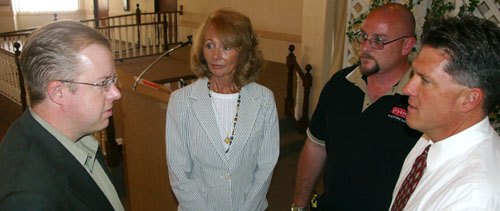
We just got back from the Hesperia Chamber of Commerce monthly luncheon in Foremost Healthcare’s ballroom. This time, the guest speaker was Stephan Wingert, the publisher of the Daily Press, Hesperia Star, Desert Dispatch and La Prensa del Mojave. Being in the news biz, Stephan came armed with a fairly newsy presentation, and he played to one of the more packed houses that I’ve seen at a chamber luncheon. (Lunch was meatloaf, mashed potatoes, cooked carrots and chocolate pudding.)
According to Stephan, there are some changes in the works for the Daily Press, in response to what advertisers want and what polling data says that readers are looking for. The changes — which will be mentioned in an article I’ll have for the August 23rd Star on Stephan’s presentation (he IS the boss, after all) — have already started, but will be kicking into high gear in September.
The audience was fairly loaded with people interested in the High Desert’s newspapers, and we heard some nice feedback one-on-one from Hesperia Star readers, so that was nice.
After much delay, here’s the final (for now) installment of Journalism 101: What They Won’t Tell You in J-School (Until It’s Too Late).
Actually, the title of this is misleading: I actually heard all of this before graduating college, but not by much. The horrified faces of those around me said that other broadcasting and journalism students hadn’t heard it until it was essentially too late either. So, in the hopes of giving people a head’s up, let’s go over the bad news. I still think journalism is a great profession — I left a kickass job in the videogame world to come back to it, after all — but aspiring journalists should go in with their eyes open.
1) No one’s kidding about paying dues. My first story was a planning commission meeting in Christiansburg, Virginia. It’s so dull that, even today, I can barely stand to re-read it. Your first stories will be the same. It will be months, perhaps years, before you have a shot at writing the sorts of stories you want. You may be the world’s greatest undiscovered cops/courts reporter, but the paper you start off with will be in Mayberry, or you’ll be inputting community events items for the Neighbors page while you wait for the cops/courts reporter to move on to another paper. (See below for more on that.) And there will be no sympathy from the people around you: We’ve all done police logs, had our butts fall asleep in brutally slow meetings and interviewed people about things that we can’t believe even the people themselves care about
2) There is no money, sorry. When I say “no money,” I mean for nearly everyone. Remember the “look to your left, look to your right, one of those people won’t be here in a month/will fail out of the class/won’t get into law school” or whatever variant you heard in school? Change that to “only one person in this classroom will make their age in thousands of dollars after age 25.”
This is because of two factors: First, pay is theoretically pegged to how much money advertising pulls in over your circulation area. Since most media outlets are in relatively stable areas, that salary is pretty much locked into a short range. You might get a few raises, but after a year or three, you’ll likely have maxed that out, unless you’re at a very, very big paper, and you’ll just get cost of living increases after that.
Secondly, the job pyramid is very, very wide. There are many more people at the entry level than there are higher up. This means that not only can the media afford to not pay you quite as much as they could if they were scrambling for candidates to replace you, it also means that competition to go up the ladder is brutal, because the pyramid never narrows: The next rung up the ladder is always flooded with applicants whenever they have a new opening. Get used to your relatively low salary, because it’s not changing terribly quickly.
3) The hours suck. And they don’t stop sucking when you get to the position you’re interested in. This is especially true for sports reporters, for whom the brass ring means missing out on all the time normal people have free, since that’s when games are played. But for all reporters, count on missing birthdays, dates, parties and more. Do I want to be working until 11 p.m. on a Monday night at least once a month? No, but I need to be there.
4) You will be disliked by much of the public in a way only ambulance chasing attorneys can really understand. I’ve been hung up on while working at the Potomac News simply for being a journalist and much more often, I’ve had to overcome enormous prejudice against me to win the trust of a source.
There’s a large and profitable infotainment industry that, on both sides of the political fence, uses the media as a go-to demon, ignoring the fact that the infotainers are, themselves, in the media. Otherwise intelligent people will buy into the hype and believe that you’re out to get them, because they heard about it on the radio, on cable TV or on the Internet. In the last election cycle, I had not one, but representatives of two city council candidates want me off the story or the paper entirely, because I was “clearly” biased against them. That it would be all but impossible to be against both candidates (who were running against one another) at the same time didn’t affect their perceptions that I was out to “get” their guy, which they appeared to genuinely believe. (For the record, if I was out to “get” someone, it wouldn’t be an arguable thing. It would be obvious, and they’d be got and stay gotten.)
Hell, I once had a stripper make fun of my career choice.
Don’t get into this job expecting to be the hero of the little guy. Even if you are that hero, you’ll never hear about it, and it’ll be forgotten the first time you write something that people don’t want to hear about.
5) It’s death on relationships. As someone married (and just on my first), I’m a freak in the journalism industry. I had a professor at Tech say, quite frankly, they went into academia to save their marriage. Every newsroom I’ve ever been in was full of the never-marrieds and the divorced. If you troll through Yahoo! Personals you can spot some of the High Desert’s journalists, looking for someone who won’t hold being a journalist against them.
So, with all that stacked against it, why be a journalist? If you’re asking yourself that, maybe you shouldn’t be one. Your skill set can be profitably turned towards a number of other jobs, all of which eliminate most or all of the problems that journalists face. But you won’t be making the world a better place, even in a small way, on a regular basis. Because informing the public about what’s going on around them, whether it’s catching their elected leaders doing things they shouldn’t be, or recognizing the unsung heroes in their community or simply letting them get to know their neighbors in a way so few people now do, that’s what journalism is all about.
Life in Hesperia is different because of the Hesperia Star, and I happen to think it’s better. That’s a heck of a good way to spend your life. (And that doesn’t even include meeting people I’d never get to meet otherwise and to see places and things I’d never have seen otherwise, like riding a blimp over RFK Stadium or talking to Bosnians in the middle of their bullet-riddled home.)
School is starting back up now, and intern season is, for the most part, over. And more importantly, I’m out of topics for right now. We’ll pick this up again by next summer.