

As I mentioned previously, I have to operate with the expectation that, as a weekly reporter, I won’t always beat the Daily Press or the Sun. And so it is that Gretchen has gotten a story to print before I could:
After four months of searching, the City Council chose Interim City Manager Mike Podegracz as the right man for the city manager post. The council tapped Podegracz during a special closed session Wednesday.
“We had about 40 candidates. We weeded them down to 15 and interviewed seven,” Mayor Jim Lindley said. “It was a field of outstanding candidates but he rose to the occasion and got to be the one that we picked.”
Podegracz is expected to take on the role as city manager Thursday. He will be the city’s fifth city manager in the past 17 years.
And it’s entirely likely the Sun will have something before Tuesday as well.
So if I can’t have it first, I’ll have to do it better. Check back here on Tuesday for what I think is the definitive story about the top government job in the city being offered to Mike Podegracz. 😉
Well, as of Tuesday, the San Bernardino County Sun did not, in fact, have this story.
And here’s my version of the story complete with more information on the process, comments from all the council members, comparative salary info and a look at Robb Quincey’s benefits, for additional insight into what Podegracz might be looking at. We’ll find out more after his contract is approved by the council.
Journalists, including ones who work for the LA Times, sometimes seem to live in a separate world from everyone else, especially when it comes to looking at their own paper’s problems.
Here’s John Carroll, who’s stepping down as editor-in-chief of the LA Times, on why circulation for the paper is declining:
Paul McLeary: One of the reasons the Los Angeles Times represents a puzzling — even disturbing — case study for the rest of us is the striking disparity between its journalistic performance (13 Pultizer prizes in five years) and its circulation performance (daily readership down 6.5 percent and Sunday readership down 7.9 percent in just the past 12 months). You must have felt at times like the gladiator who keeps vanquishing foes in the arena, yet every time he looks up at the bleachers, people are filing out the exits. As the guy who lived that paradox, do you have any insights into it to share?
John Carroll: I believe content had nothing to do with the circulation decline; if anything, the decline was mitigated by our content. Where does the blame lie? The list is long: 1. The scandal at Newsday, which prompted both our internal auditors and the Audit Bureau of Circulation to disallow certain types of sales that were previously considered legitimate. 2. The advent of the “do not call” list, which stymied our phone sales. 3. The reduction of the newspaper’s cost base by more than $130 million annually, which cut the strength of marketing and promotion efforts, among others. 4. Issues on the business side that recently prompted the appointment of new directors of circulation and marketing. 5. And, of course, increased competition for readers’ time. That’s only a partial list.
It’s not even on his radar that the paper feels incredibly irrelevant to many Angelenos, despite the fact that the LA Times’ circulation numbers are dropping faster than the competing papers’ are.
Let’s be honest here: Angelenos know where to find the LA Times. They know how to get a subscription if they want one. Telemarketers being rebuffed by the do not call lists should have only the slightest dent in circulation numbers. People aren’t reading the LA Times because they don’t want to. And that, Mr. Carroll, is absolutely all to do with content.
“Increased competiton for readers’ time” is publishing speak for “Internet,” and it’s the same sort of nonsensical boogeyman Old Media heads have been trotting out since the World Wide Web made its debut. Because, despite the fact that newspapers use text and static images, the two forms of media most easily placed on the Internet, the old guard has remained wedded to distributing their content on recycled pulp instead of rising to meet the challenges of the Internet.
Of course, that’s hardly surprising: Most print media still haven’t come to grips with the challenge presented by radio broadcasts, which will be 100 years old in 2006. Even today, newspapers are filled with stories that presuppose readers have no access to radio, TV or Internet for breaking news, when they obviously have access to some or all of these. So we get often the same Associated Press reports initially read on the radio (or printed on the Internet) at the time of the incident, instead of the longer, more in-depth pieces that the longer news cycle for a newspaper can deliver. If you have up to 24 hours to create more substantial coverage at a daily newspaper, why on earth would you think readers would settle for the quickie AP summaries they got the day before? (Obviously, as the length of time between publications increases, so should the length and depth of coverage, something that news magazines have understood relative to newspapers for decades, perhaps even forever.)
And this is even more true for local coverage, which is something that typically only the local newspapers are doing anyway, especially if it’s about something other than fires or shootings. If a newspaper is just covering the same fire readers saw on the TV the night before, in the same way, there’s no reason to pick up the paper, and who can blame them? Yet, from the smallest town to the largest city, there’s a ton of news happening that won’t get covered by the broadcasters or (via the AP and its competitors) the Internet. That is what should be in the newspaper, on the front page, above the fold, so it’s visible through the window on newspaper boxes. “We have something to tell you about that no one else has told you!” Tell your readers that, and they’ll find the time to make the paper part of their daily lives. Don’t, and they won’t. It’s just that simple.
But no, the LA Times’ problems are due to changes in telemarketing, despite the fact that single copy sales are falling faster than subscription sales. That sound you hear is the chamber musicians playing on the deck of a sinking Titanic.
A less-sweeping but similar take on this can be found at LA Observed.
None of this is unique to me, so if I sound like I’m breaking my arm trying to pat myself on the back, I’m not. I just have a first-person source (me) that can speak about this issue.
When I was in college, after realizing that I didn’t want to be a disc jockey (the lonely little off-campus WUVT studio smelled like stale coffee, stale cigarettes and stale sweat and was a lot lonelier than I had imagined), I ended up in an Electronic News Gathering class. ENG was just a fancy way of saying “hey, kids, let’s put on a weekly cable news show.” It was, for lack of a better way of phrasing it, when the career of journalist “clicked” for me. I would sling my camera over my shoulder, tuck my microphone under my arm along with my tripod, and suddenly I could go almost anywhere and be a witness to almost anything. Through the lens, I had a new way of looking at the world, one that forced me to look at the world with new eyes and find that everyone has an interesting story to tell. It was a mind-blowing realization. (And that was just the cut form of the journalism drug — even a whopping two minute story is nothing like the 100 inches I can devote in print to a really complicated and meaty news story when necessary.)
But the learning process wasn’t entirely smooth. My teacher, Steve Anderson, an Emmy award-winning weatherman and environmental reporter from Denver, regularly fussed at me for not shooting “stand-ups” when I was playing a one man band of reporter-photographer-editor. These are a staple of television news where the reporter is filmed standing in front of something (hopefully relevant to the story) and identifies where they’re standing, who they are, and who they’re reporting for. I simply wasn’t interested in doing this. It wasn’t because of a lack of ego (lordy, the ex-girlfriends can testify about that one), but rather, I didn’t want to waste what little time I had in the story on it. A long news story is two minutes. Pick a random news story from Yahoo! News and read it at a measured pace: You won’t get through it in two minutes. You probably won’t even get to the “meat” of the story. So sacrificing 5 seconds of a story that might only be 60 seconds just so I could say my name and that I was in Blacksburg seemed wasteful in the extreme.
Because, here’s the thing: The audience doesn’t give a crap. The ability to report live from across the planet or even next door is no longer a novelty, and it’s no longer a bragging point that needs to be dangled in front of the audience. This is especially true for live-on-tape footage shot just outside the dorm room the audience will be in when they watch it. Standing outside West Eggleston Hall isn’t an impressive feat to a person who lives there. (Obviously, Anderson was right to insist I learn how to do them, though, since it’s what employers would want me to know how to do. The debate over whether to do them didn’t mean I should be unprepared for the working world.)
And this principle holds true for print journalism as well: The audience wants to read the story and get the information. With rare exceptions, they do not care about what a dazzling writer you are, especially since most journalists aren’t. When reading a story, they want the information clear, they want it succinct (but still complete enough to understand the facts of the case) and they want to get a sense of what it was like to be on the scene themselves. While doing all of that well requires the writer to exercise his or her craft, it also requires knowing to get out of the way when needed.
Which brings us to the art of the quote. I quote early, I quote often, and nine times out of 10, I close with a quote. I paraphrase only when the subject does not explain things clearly (people don’t speak in complete sentences, and sometimes, even a clear explanation can’t be used as a quote). Getting the original source speaking let’s the reader feel like they were really there, without all that tedious going to meetings or standing around waiting for something to happen. And quotes impart things that a reporter is unlikely to mention in an average length story. Is that city councilman a good ole boy? His quotes will reflect that, especially if the reporter accurately represents the way the councilman phrases things.
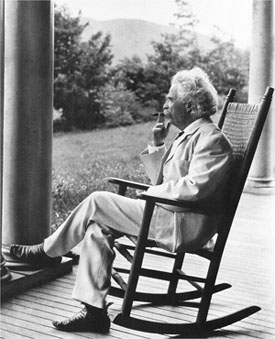 Some newsrooms clean up quotes to the point of fixing grammar, removing dialect and so on. While this normally stems from noble intentions — “let’s not make people not take so-and-so seriously, just because she doesn’t have a great education” — it fails to accurately represent the person doing the speaking. There was a reason that journalist Mark Twain used dialectic speech in “Huck Finn“: Understanding who the characters were included letting readers hear how they spoke. Some newsrooms clean up quotes to the point of fixing grammar, removing dialect and so on. While this normally stems from noble intentions — “let’s not make people not take so-and-so seriously, just because she doesn’t have a great education” — it fails to accurately represent the person doing the speaking. There was a reason that journalist Mark Twain used dialectic speech in “Huck Finn“: Understanding who the characters were included letting readers hear how they spoke.
Now, just as people don’t tend to speak in complete sentences, they often aren’t terribly concise. So reporters use several tricks to form better quotes, especially cutting apart relevant sentences and stitching them together with ellipses (“those dots”: …). Obviously, this has to be done prudently: If you change the meaning of what someone said, or misrepresent how they said it, you’re not only violating the trust of the readers, you’re risking a backlash from the source. I know more than one source who won’t talk to certain reporters because of the risk of getting misquoted. So it’s a tightrope to walk, which is why many reporters decide to just paraphrase instead.
But paraphrases can never approach the power of a good quote, in my mind. Here’s a good example from a recent story by the Daily Press’ Gretchen Losi:
Walking through the door, Martha Weis followed her nose to the samples of warm, homemade bread from Shelly’s Place.
“Oh man, this is so good,” Weis, of Hesperia, said. “Mama ain’t got nothing on this stuff.”
Weis then spent another couple of hours visiting the vendors and nonprofit groups exhibiting at this year’s Hesperia Community Expo at Sultana High School.
It would have been possible for Gretchen to paraphrase Martha Weis:
Weis enjoyed a piece of bread from Shelly’s Place.
That’s fundementally the same thing as the quote she used, but by using the quote, Gretchen showed us both how much Weis enjoyed the bread and gave us a little feel for how Weis talks, at least when she’s eating tasty fresh baked bread. Gretchen’s a good writer, and in this case, she showed it by knowing when to get out of the way and let a source tell the story even better than she could.
Next week, we’ll talk about writing vs. reporting.
I was surprised to see this ad at JournalismJobs.com:
The Las Vegas Review-Journal, circulation 165,000 daily/240,000 Sunday, is looking for aggressive and enterprising reporters who refuse to be beaten, and have the clips to prove it. We seek an experienced government reporter, a tenacious watchdog with a record of exposing public corruption. For anticipated openings, we also seek reporters who thrive on covering all manner of breaking news, including crime stories. Send resume, cover letter and a half dozen clips or more to City Editor Mary Hynes, Las Vegas Review-Journal, P.O. Box 70, Las Vegas, NV 89125-0070. No e-mail applications, please.
The Review-Journal is the paper of record for Vegas, and as a major metropolitan daily, they can afford to only hire the best and most experienced. Surprisingly, they’re not limiting their search like that. I think the odds that a relative rookie could get hired there are slim, but it’s nice to see them casting such a wide net in their search for the right writers. The New Orleans Times-Picayune did something similar last year.
And no, no plans to apply or leave the Star right now, although both the Review-Journal and Times-Picayune are the types of paper where I could happily spend the rest of my career; I was just looking out of curiosity, given that our intern is looking for a long-term job.
When I was at my second newspaper gig, Dear Newspapers in McLean, Virginia, I was under the tutelage of managing editor R. Cort Kirkwood. Cort, now the editor of the Daily News-Record in Harrisonburg, Virginia, and I both have strong personalities, and we clashed a fair amount. But I learned a quite a bit at Dear. (Not to mention made a friend in education reporter Todd Behrendt, who later helped me get a job at the Potomac News, where he had landed while I was still freelancing in Egypt.)
 One of the things Cort spent a lot of time focusing on was making sure that none of our four-person reporting staff wrote stories that were too “inside baseball.” In other words, not too wrapped up in the nitty-gritty insider details that were of no real interest or relevance to the average reader, like a sports story that discusses arcane personnel issues instead of the who, what, where, when, why and how of the actual game. One of the things Cort spent a lot of time focusing on was making sure that none of our four-person reporting staff wrote stories that were too “inside baseball.” In other words, not too wrapped up in the nitty-gritty insider details that were of no real interest or relevance to the average reader, like a sports story that discusses arcane personnel issues instead of the who, what, where, when, why and how of the actual game.
Another way he approached this, in a way that’s been more applicable to me throughout my career, was that “every story is someone’s first.” The reader at home doesn’t care if you’re tired of writing the background and the context on some complicated issue over and over again in subsequent stories. For some of them, those follow-up stories will be the first time that they’ve been exposed to the issue, and they need that background, whatever your feelings on it might be at this point. It’s certainly something I’ve had to remind myself of numerous times over the years, especially with complex stories like the progress of the Hesperia casino proposal.
I don’t always succeed on these two related points, but it’s something I try to bear in mind. It worked out well in one illustrative case, when I picked up a Virginia Press Association award in 1998 for play reviews I wrote at the Potomac News. The secret of my success: Cort’s advice. Although I have a reasonably strong background in theater, I wrote for a regular person who just wanted to know whether or not a given play was worth seeing and why.
I wrote the reviews as though I was telling my mom about them. Mom’s a smart cookie, but she also doesn’t really care about blocking or technical intricacies or backstage politics. She, or at least the imaginary version of her I used as my audience while writing, wants to know 1) what the play is about, 2) some examples of what it’s like and 3) whether or not to see it. It would have been very easy to slip into talking about the inside baseball aspect of the plays, but Cort’s advice (OK, his barked orders) came back to me over the years and steered me right.
Remember the readers when you’re writing. That’s your audience, not the editors and not other reporters and not even the newsmakers themselves.
Next week, we’ll talk about the art of the quote.
|
|
|
|