

Spoiler alert: It’s a revenue model issue, specifically, print advertising versus online advertising.
Some have noted that it could make sense, from the perspective of circulation economics, to induce newspaper readers to switch from print to iPad. That well may be true: The savings on circulation marketing, printing, and delivery costs would be significant. Such inducements could take the form of discounts on iPad purchases. The Times has actually experimented with an analogous program using Times Reader and a Samsung netbook, offering $100 off the hardware to new non-print subscribers to the software.
But newspaper economics are not limited to circulation economics. In fact, most newspaper revenue comes from advertising. And one of the most important realities about the state of newspapering these days is that online advertising revenue, on a per reader or per impression or any other relevant basis, lags so far behind print revenue that it seems destined to never catch up—never to come even close.
Thus, it has been clear, for perhaps three to five years, that any sudden conversion of all print readers to Web readers, while greatly reducing costs, would reduce revenue even more, deepening losses at unprofitable papers and throwing those that remain profitable into losses—losses that would likely be impossible to reverse except through huge further expense cuts, especially in newsrooms. The downward spiral in product quality would be accelerated, likely leading to fewer readers and more cuts.
And this is a pretty major stumbling block. Every time the otherwise quite insightful folks at Buzz Out Loud start in on how it’d be great if newspapers would just stop worrying about paper, they forget about advertising, causing me to yell at my car stereo while I’m driving.
(From The Daily Beast, which I’ve somehow managed to avoid stumbling across until now.)
A former coworker linked this article on Facebook, which makes the very dubious claim that DC invented chili mac, a dish I grew up eating.
What makes it dubious, for starters, is that the Hard Times Cafe’s “chili mac” was actually Cincinnati chili — chili served over spaghetti noodles, although the Hard Times version was less sweet than the Cincinnati versions I’ve tried over the years. The chili mac I had growing up was two cans of Hormel chili (one with beans, one without) served over a bunch of elbow macaroni, with dried Kraft Parmesan cheese shaken on top. (Today, at home, we use Stagg Dynamite Hot chili and refrigerated shredded Parmesan.) Hard Times did do the shake cheese thing, though.
My mom, who served it to us as a way to stretch the family’s food budget until payday, learned it from her mother, whom I don’t think ever went anywhere near Washington, DC, until after I was already born.
Looking online, I see a lot of people claiming that chili mac is a derivation of Cincinnati chili, which doesn’t make a lot of sense, etymology-wise. Wouldn’t it be “chili-ghetti” or something, then?
There’s an appalling (to me) lack of scholarship on this subject. Chef Boyardee (who turns out to have been an actual guy originally named “Boiardi”) had a single can version of the dish starting in the 1970s and the U.S. Military now has a version as an MRE (Meal Ready to Eat ration), but that also seems to be a recent thing, with no precursor in the older c-rations the military used to eat.
But the origins of chili mac may actually be almost as old as normal chili, and date to the same part of the world: The oldest citation I’ve found is this claim that it’s a Texas recipe dating to at least 1918!
I am excessively curious about this. Does anyone have any additional insight into this?
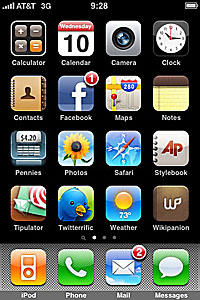 Peter just got an iPhone — which is especially good for him, since he’s a Mac guy, and the calendar and contacts will automatically sync up with the Apple applications on his home computer — and I figured it might be worth listing what apps I’m currently using on my iPhone. Note that these aren’t all in alphabetical order, because I’m going screen by screen (I use three screens) and some of the apps are in there as ways to distract James. Peter just got an iPhone — which is especially good for him, since he’s a Mac guy, and the calendar and contacts will automatically sync up with the Apple applications on his home computer — and I figured it might be worth listing what apps I’m currently using on my iPhone. Note that these aren’t all in alphabetical order, because I’m going screen by screen (I use three screens) and some of the apps are in there as ways to distract James.
* Facebook – Free, and arguably better than the actual Web client
* Pennies – Low-cost (I don’t remember the exact cost), and a not terribly detailed budgeting tool. My only gripe with it is that it’s based around a monthly budget and automatically resets the money available on the first of each month.
* Stylebook – The AP Stylebook, on my phone. It’s not super-fast on the iPhone 3G (to put it mildly) and it costs real money, but it’s extremely useful for a working journalist.
* Tipulator – For the lazy people like me, who don’t want to engage their brains when splitting complicated checks. Great graphical user interface. Low cost.
* Twitterific – An ad-supported Twitter client that can handle multiple accounts. So I can switch between my personal account and the Hesperia Star’s account at will.
* Wikipanion – A very nice Wikipedia client (and much easier than reading it via the Safari Web browser). The free one, which I use, doesn’t save data for offline viewing, so the paid one is probably a better choice for iPod Touch users.
(more…)
There are a lot of people jumping up and down about the news that Newsday only got 35 subscribers to its behind-the-paywall Web site after three months, especially in light of the news that, like someone returning to a bad relationship once again, the New York Times will be returning to a pay model again soon. (This time, in a “freemium” model that actually seems pretty reasonable.)
So, three months later, how many people have signed up to pay $5 a week, or $260 a year, to get unfettered access to newsday.com?
The answer: 35 people. As in fewer than three dozen. As in a decent-sized elementary-school class.
The web site redesign and relaunch cost the Dolans $4 million, according to Mr. Jimenez. With those 35 people, they’ve grossed about $9,000.
In that time, without question, web traffic has begun to plummet, and, certainly, advertising will follow as well.
Of course, there are a few caveats. Anyone who has a newspaper subscription is allowed free access; anyone who has Optimum Cable, which is owned by the Dolans and Cablevision, also gets it free. Newsday representatives claim that 75 percent of Long Island either has a subscription or Optimum Cable.
“We’re the freebie newsletter that comes with your HBO,” sniffed one Newsday reporter.
Mr. Jimenez was in no mood to apologize. “That’s 35 more than I would have thought it would have been,” said Mr. Jimenez to the assembled staff, according to five interviews with Newsday staffers.
“Given the number of households in our market that have access to Newsday’s Web site as a result of other subscriptions, it is no surprise that a relatively modest number have chosen the pay option,” said a Cablevision spokeswoman.
Those are pretty big caveats. The number of people in Long Island that don’t have a Newsday subscription or a Cablevision hook-up is pretty small. And while Newsday staffers may believe otherwise, the rest of the world really doesn’t care about their coverage of national or international news.
And that Web site usage is dropping off because it’s a terrible Web site. It looks like a poorly thought-out site for a CW television station, not a site promoting print news.
The Newsday paywall experience is more about what happens if you have good penetration with other subscription models and a worst-in-show Web site, not the viability, or lack thereof, of paywalls.
(And really, New York Observer? You’re going to take shots at any other paper, while printing yours on pink, excuse me, salmon newsprint? Really?)
You also have to watch out for supervillains destroying your building. Ironically, the newspaper bailout that Electro was apparently so mad about apparently stands little chance of happening in real life. (I couldn’t even find any news references to it after September 2009, which doesn’t exactly suggest it’s still chugging along on Capitol Hill.)
Although J. Jonah Jameson’s newsroom was supposed to be a scary environment for Peter Parker, even as a kid, I realized that the Daily Bugle was a heck of a lot more realistic than the bland Daily Planet that Clark Kent worked at. Jameson and much of the rest of the staff are pretty recognizable newsroom staples, to the extent that I suspect a lot more people with actual knowledge of newsrooms have written stories relating to the Bugle than ever have dealt with the Planet.
Of course, this is comics, after all, where Superman can die, Batman can get his spine snapped, get better, and then later die, and eventually, it all works out. So the Bugle will be back in some form, eventually. Hopefully not as a TV station, which some fans seem to think is a more realistic choice — the issues of Amazing Spider-Man leading up to the Bugle’s destruction in December talked about the state of the newspaper industry repeatedly — when broadcast news is also facing its own substantial challenges. The folks at Marvel Comics’ House of Ideas will probably have to come up with a novel solution all their own on how to revitalize the Daily Bugle — and, frankly, the newspaper industry could use the help in that regard.
|
|
|
|