

Here’s an irony for you, those of you who collect and trade ironies:
DC Comics‘ Elseworlds – what we older fans once knew at Imaginary Stories, although that apparently wasn’t as exciting to the marketing department – mostly suck. That’s not to say that all of them do, but as the concept wears on, and Bob in accounting gets his chance to write on, the quality level has dropped from the heights it started at (with either “Batman: The Dark Knight Returns” or “Batman: Gotham by Gaslight,” depending on where you begin counting from) to even lower than the average DC Comic. Why it’s dropped so low is open to discussion, but it’s hard to say that they’ve been knocking the ball out of the park every time at bat.
This problem has been particularly acute in the non-Prestige-Format-pay-five-bucks-or-more Elseworlds, like annuals or a particularly dreadful issue of the otherwise quite nice “Batman Chronicles.”
Additionally, DC’s 80 Page Giants also mostly suck. Sure, there’s always one or two good stories in each – Tom Peyer seems to be responsible for most of those, now that I think about it – but they never justify their $5 price tag. Mostly they seem to be ways to keep underemployed creators in work and … well, no, that seems to be about their purpose in life. They’re certainly not a celebration of the short story, since so few of the ones told in the Giants are any good.
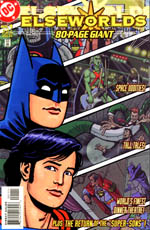 So it was with zero anticipation that I awaited the arrival of the “Elseworlds” 80 Page Giant earlier this year. So it was with zero anticipation that I awaited the arrival of the “Elseworlds” 80 Page Giant earlier this year.
And kept on waiting.
And waiting.
And waiting.
And then it was revealed that, lo and behold, publisher Paul Levitz had pulled the plug on the book after it had gone to the printers – and long after it had been through the editorial process and had been thoroughly looked at by all those in the loop, including, apparently, Levitz. Alas for Levitz, since Britain normally gets their books later than the U.S., some bright lad had chosen to print off roughly 1,500 copies early for Britain, and shipped them off before the “do not publish” edict was handed down.
One has to love the Internet. That one, of course, being me. In addition to all the rest it’s done for me – found me a wife, gotten me two jobs, let me geek out and talk to creators whose work I’ve loved for years – it also got me a wedding present of one of the 1,500 copies of “Elseworlds” 80 Page Giant.
Here’s the big irony, for those of you wondering what it is: “Elseworlds” 80 Page Giant, combining both the lackluster Elseworlds and the less than lackluster 80 Page Giant format, is a winner.
Since most people may never see it – DC has been apparently embarrassed about the whole situation and thus slow to remove the offending story and republish the thus 70 Page Giant – here’s a comprehensive review. (I’m not scanning the whole damn book in, no. DC’s lawyers should scare everyone and they certainly scare me.)
The first story, “The Reaching Hand,” by D. Curtis Johnson and Aaron Lopresti, is a Lovecraftian horror story set in Gotham, with detectives Bruce Wayne and Harvey Dent investigating strange deaths in Arkham Asylum, with the help of their assistant, James Olsen. The story’s not any big surprise, given both the name and the fact that the first death is one Ralph Dibny. But it’s neat to see stretching powers viewed through the lens of “god, that’s kind of creepy.” The writing is appropriately overwrought, Dent’s descent into crazed obsession the same. There’s an in-joke I suspect I’m not getting – the chant “H’Ya Yag-F’Nagh!” – but it’s an enjoyable little story, and the Cthonic villain who rises from the depths below Gotham makes sense and wasn’t one I guessed. (The punchline at the end of the story was, however, telegraphed, but Lopresti does such a good job making stretching unpleasant that it hardly matters.)
Next up is Bronwyn Carter and Greg Luzniak’s “Rockumentary,” which tells the story of Lex Records. It’s probably the weakest story in the volume, but no stinker in the vein of so many other 80 Page Giants. Basically, toss in some Good Girl art, the All Stars and Blackhawks as swing and jazz bands, and the core Silver Age heroes as the Beatle-esque Heroes and you’ve got the idea. The story doesn’t take the imaginative leaps it ought to – Black Canary shows up as an interviewer, instead of in some singing role and why Ra’s Al Ghul is in the story at all is a little confusing – but there’s some other clever bits, with an Indigo Girls-like Harley and Ivy and the Teen Titans being a Menudo-like group with an ever-changing, always-young roster.
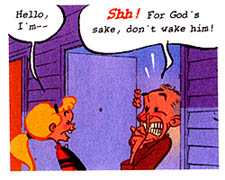 Then we come to the deal breaker, the story that kept the book from being published, “Letitia Lerner, Superman’s Babysitter!” by Kyle Baker, with Elizabeth Glass and David Gaddis. This is a cute little story about the Kents getting a night in a hotel room by paying the aforementioned Letitia to stay and watch the infant Clark. Reading this – and it’s very cute – I have to assume that Levitz has never seen a Warner Brothers cartoon, which for years featured indestructible toddlers making their signature characters crazy trying to keep them safe. OK, so Baby Clark gets trapped under a boulder, swings on a ceiling fan, sucks milk directly from a cow, wanders into traffic and eventually gets microwaved. Which one of those acts was Levitz thinking would result in copycat behavior? I watched Looney Tunes for years and never once did I drop an anvil on my little brother. Even when he deserved it. The worst thing about this story is that, in the end, it’s so damn good. This would have been the standout if fandom had gotten to see this 80 Page Giant. And knowing that it’ll probably be excised when/if the book is ever republished is just sad. Then we come to the deal breaker, the story that kept the book from being published, “Letitia Lerner, Superman’s Babysitter!” by Kyle Baker, with Elizabeth Glass and David Gaddis. This is a cute little story about the Kents getting a night in a hotel room by paying the aforementioned Letitia to stay and watch the infant Clark. Reading this – and it’s very cute – I have to assume that Levitz has never seen a Warner Brothers cartoon, which for years featured indestructible toddlers making their signature characters crazy trying to keep them safe. OK, so Baby Clark gets trapped under a boulder, swings on a ceiling fan, sucks milk directly from a cow, wanders into traffic and eventually gets microwaved. Which one of those acts was Levitz thinking would result in copycat behavior? I watched Looney Tunes for years and never once did I drop an anvil on my little brother. Even when he deserved it. The worst thing about this story is that, in the end, it’s so damn good. This would have been the standout if fandom had gotten to see this 80 Page Giant. And knowing that it’ll probably be excised when/if the book is ever republished is just sad.
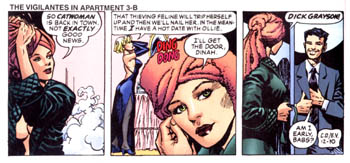 Chuck Dixon isn’t known for being Mr. Funny, but “The Vigilantes in Apartment 3-B,” with art by Enrique Villagran might just change that. Babs and Dinah are a pair of sexy roommates in this set of seven newspaper strips, who just happen to be the crime fighters Black Canary and Batgirl as well. The strip includes their dating perils, a gratuitous shot of Babs in a half-open bathrobe and a romantic reversal for one of the girls. It’s a fun riff on the venerable cheesecake “Apartment 3-G” newspaper strip. Chuck Dixon isn’t known for being Mr. Funny, but “The Vigilantes in Apartment 3-B,” with art by Enrique Villagran might just change that. Babs and Dinah are a pair of sexy roommates in this set of seven newspaper strips, who just happen to be the crime fighters Black Canary and Batgirl as well. The strip includes their dating perils, a gratuitous shot of Babs in a half-open bathrobe and a romantic reversal for one of the girls. It’s a fun riff on the venerable cheesecake “Apartment 3-G” newspaper strip.
And then there’s the return of the Super-Sons from the 1970s “World’s Finest” title. Apparently, this story, by original Super-Sons writer Bob Haney and artist Kieron Dwyer, is set in the modern day, not the hipster 1970s the characters previously occupied. Personally, I liked Superman with sideburns, but maybe that was just me. The story is a little creaky – Haney’s dialogue isn’t exactly cutting-edge – but it’s a hoot to see the teenage Superman and Batman treating issues like “gee, my Dad Superman will be around forever, so I’ll always be in his shadow” seriously. And the sight of the original World’s Finest team together is also cheesy fun. (I happen to think making Superman and Batman something less than bosom buddies, as has been done since “Crisis on Infinite Earths,” is a realistic and appropriate characterization.) The one really nice part of this story is its method of (trust me, this isn’t a spoiler, but rather the point of the story) killing the senior Superman: Of course, this is also why he wouldn’t tow a giant sack with all the world’s nuclear warheads behind him through space.
Then comes the first of the obligatory very funny Tom Peyer pieces: “Scandalgate,” with art by Ty Templeton. President Superman is embattled with an unspecified crisis, and the supervillains are harrying him: Zod is the special prosecutor, Silver Banshee and Metallo are cable news commentators and all the assembled supervillain/journalists will ask press secretary Jimmy Olsen is “You young fool! Do you expect your hero to save you now?” Very funny, and to the point, with Lana Lang’s comment “I’m sick of the whole thing! I just want it to end!” Funny stuff, although it won’t be at all topical (one hopes) whenever the edited version of this special sees the light of day.
Chuck Dixon’s second story in the giant – and, yeah, there’s a lot of stories in this, and it’s impressive how many of them are entertaining – posits the rather icky scenario “what if the Waynes had died because Kal-El’s rocket had smashed into them on the way back from the movie theater?” It gets icky immediately, with the much-missed Trevor von Eeden having little Brucie’s face get blasted in the splash page. Lex Luthor steals the baby Kal-El and the story spirals off in a very dark direction from there, ending in the most bleak manner possible. Neat stuff, and more classically Elseworlds, for better or worse, than most of this comic.
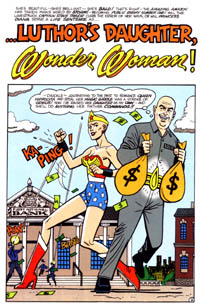 Mark Waid and Ty Templeton visit the “DC’s Hall of Silver Age Elseworlds” next, unleashing the first pages of the very funny “President Abraham (Brainiac) Lincoln versus Clark Kent, Metallo,” “Luthor’s Daughter, Wonder Woman,” “Batman with Robin, the Squid Wonder,” “The Golden Age Teen Titans,” “A new tale of the Legion of Super-Heroes: The Revenge of Young Darkseid!,” “Menace of the Gorilla-Explorer” featuring Christopher Grodd Columbus, the Metal Men in “Liberte, Egalite, Metallica” and, my favorite, the hilarious “Batman with Eve” in “Garden of Evil!” which contains the classic line “I must be careful! I can’t let Eve know that her protector, Batman, is secretly her husband Adam!” Mark Waid and Ty Templeton visit the “DC’s Hall of Silver Age Elseworlds” next, unleashing the first pages of the very funny “President Abraham (Brainiac) Lincoln versus Clark Kent, Metallo,” “Luthor’s Daughter, Wonder Woman,” “Batman with Robin, the Squid Wonder,” “The Golden Age Teen Titans,” “A new tale of the Legion of Super-Heroes: The Revenge of Young Darkseid!,” “Menace of the Gorilla-Explorer” featuring Christopher Grodd Columbus, the Metal Men in “Liberte, Egalite, Metallica” and, my favorite, the hilarious “Batman with Eve” in “Garden of Evil!” which contains the classic line “I must be careful! I can’t let Eve know that her protector, Batman, is secretly her husband Adam!”
And the final story, “Dark Knight of the Golden Kingdom,” would seem mean to anyone who didn’t know that writer Tom Peyer is good friends with “Kingdom Come” writer Mark Waid, since this story mercilessly parodies it, as well as other dystopian Elseworlds. The editorial notes of “from the Bible!” are priceless by themselves, but it just gets better, with the melodrama of Jimmy Olsen having held down the signal watch for 20 years, hoping Superman will return, or the ridiculous children of the superheroes – including a half-Aquaman/half-Hawkman, a half-Fire/half-Black Canary, and the way way way over the top dialogue – which reaches its peak with Batman lecturing Superman with the incomprehensible “Tremble in your sunsplashed world, with its flying pets and bottle cities and x-ray eyes that see everything but the horrible truth! Ignore the bitter realities that lurk in the night, waiting, breathing, waiting. I can’t. I never could. Because hiding won’t bring back Billy, Ollie, Wally, Donna, Dinah and Diana!”
Is this worth paying the, what, $100+ for a copy of the comic on eBay? Probably not, but then, I don’t feel any comic is worth those prices. Is it worth nagging DC Comics about publishing this comic, ASAP? You betcha. ’cause at long last, they’ve got a winner of an 80 Page Giant. They just refuse to show it to you.
Special thanks to my good friend Daniel Merlin Goodbrey, whose wedding present of the “Elseworlds” 80 Page Giant marks him as a very cool guy indeed.
This story expands on a story that originally appeared in the December 31, 1998 edition of the Comic Wire at Comic Book Resources.
Over the last few years, DC Comics has put its “skip weeks” – the occasional fifth week every few months that don’t fit into the monthly publication schedules – to good use. The “skip weeks” have been turned into occasions for themed sets of special issues, like the DC/Marvel “Amalgam” titles, the “Tangent” books, “Girlfrenzy” or “New Year’s Evil.” But there’s always been a minority of fans who have felt the events were wasted opportunities, that these events never have any real “importance” to the comics of the regular year.
They can’t say that any more.
December 30, 1998 saw the publication of “The Kingdom” #2, the concluding part of a special event featuring a return to the characters and setting of the fan favorite 1996 “Kingdom Come” miniseries.
But the book did much more than that. Thirteen years after the DC Universe’s cosmology was radically streamlined, with an infinite number of universes winnowed down to just one, in the “Crisis on Infinite Earths” limited series, “The Kingdom” threw those closed doors back open again.
The decision to have a sequel to the series hasn’t come without fan criticism of its own. But according to Mark Waid, the writer of both the miniseries and the new set of specials, DC Comics knew they wanted a follow-up to “Kingdom Come” from almost the beginning.
“Kingdom Come” artist “Alex [Ross] and I were invited to discuss it with [editor] Paul Levitz before the fourth book shipped, during 1996’s San Diego convention,” Waid told me on December 28.
Initially, the talk was of an ongoing series, set in the modern day DC Universe.
“Alex and then-‘Kingdom’-artist Gene Ha wanted the series to begin, as I recall, with an arc which had a lot to do with the 1998 super-heroes’ relationships with their respective gods. I know that one of us — and if it wasn’t me, I’m sure Alex will set that straight — suggested that Gog himself could be the last of the ‘Old Gods’ who preceded [Jack] Kirby’s New Gods. Unfortunately, with that in place as a working concept and after I produced many, many, MANY pages of notes, plots and outlines in this direction, someone at DC told us we couldn’t go there because [then-‘New Gods’ writer John] Byrne – or someone – was apparently planning/had already seeded ‘the last of the Old Gods.’ Bang, zoom, all those plans gone. Swell. In the meantime, Alex and Gene were still hot on the Olympian/Kryptonian/Shazam/etc. gods connection, and while it sounded great, while I knew that’s where Gene’s heart was, I just couldn’t turn it into something I was comfortable writing given the circumstances, and with deep regret, we mutually decided to all go our own separate ways. At one point, I know Alex and Gene were lobbying to do their story as a separate work at DC, and I was all for it. Don’t know what became of that.”
Here, as has been documented by the Comic Wire and elsewhere, notably including December’s “Wizard” magazine, the two “Kingdom Come” creators’ vision of “The Kingdom” became very different indeed.
“At that point, I elected to start from scratch and jettison any ideas that had been Alex’s – not out of petulance, purely out of creative courtesy. I had become quite taken with Magog and began blocking out an origin for him which transformed him from a parody into a complex and unique character. Those plans are still viable and that’s a story I’d like to tell someday; maybe I’ll get there. But that wasn’t working out either, not at that point. Sadly, none of the 50 pages of outlines and notes I have on the stillborn ‘Kingdom’ ongoing ever quite gelled, and though there are still a lot of workable ideas in there to be mined, most of them will never see the light of day. In fact, long before ‘Gog’ #1, I’d written an entire 38-page Magog-centered ‘Kingdom’ #1 which no one loved, including myself, and which no one will thus ever see.”
While “The Kingdom” wasn’t stillborn, its birth was a troubled one, and the project only began to get back on track about last year, in time for the “New Year’s Evil” week of specials.
“Finally, about the time I offered to do ‘Gog’ #1 as a show of good faith that I hadn’t altogether forgotten about my promise to do a KC follow-up, the pieces began to come together,” Waid said. “Still, until Grant Morrison, Tom Peyer, Dan Raspler and I sat together last summer and created Hypertime, ‘Kingdom’ didn’t crystallize. After that meeting, it was set, and the plot suddenly moved like clockwork.”
That fortuitous moment, one that would ultimately reshape the modern DC Universe, came during last August’s San Diego Comic-Con International. Beyond just an idea that felt right to the creators assembled, Waid felt that “The Kingdom” merited a grand gesture of some kind.
“DC’s pitch to me was to do ‘Kingdom’ week as a bunch of one-shots. I didn’t think that was what the readers had been waiting two years for and pushed to bracket those books within a greater story – but didn’t know what that story WAS until all the bull sessions began to make it apparent that, with the encouragement of Dan Raspler, I could use this opportunity to affect not simply the KC Universe, but the entire DC Universe.”
Who actually came up with Hypertime, though, is tough to say.
“Hell if I know,” Waid said. “As far as I’m concerned, it came from all four of us working in tandem. As far as I remember more specifically, I think I had the basic notion that Gog was inadvertently killing Supermen from different timelines, at which point Grant was the one who realized how that meant that ‘it’s all true,’ that all our stories existed in one big Kingdom. I came up with the name Hypertime, Tom was the one pressing hard to keep us from thinking of it as simply a return to pre-Crisis and instead to shape it into a more modern spin on the old ‘multiple Earths’ reality, and I’ll never forget Grant actually showing me, early one morning weeks later, the cocktail napkin upon which, in typical Morrison-channeling-Einstein fashion, he’d actually DRAWN Hypertime. Who ‘created’ Hypertime? I prefer to believe that it was there all along and we just found it.”
While Hypertime is briefly explained in “The Kingdom” #2, Waid offered this explanation by way of clarification:
“Hypertime is our name for the vast collective of parallel universes out there, in which you can somewhere find every DC story ever published – but it’s also more than that. The standard model of parallel timelines is the branches of a river, right? The main timeline is the main stream while tributaries symbolize the alternate timelines? Well, imagine that sometimes those tributaries feed back IN to the main stream, sometimes for a while, sometimes forever. Other times, they cross OVER for only a MOMENT before going in an altogether NEW direction – and for the most part, no one notices these discrepancies but the fans. In short, the reality of the main DC Universe is a lot more malleable than we’ve ever given it credit for and allows for more wonder and more possibilities than we’d ever imagined.”
Rumor has long had it that an already-published comic set in the DC Universe featured something that could only be explained by Hypertime. What was it? Try Waid’s last big name limited series.
“Best simple example: the use of the Blackhawks in ‘JLA: Year One.’ According to some DC stories, Chuck and Andre were killed during the 1950s and couldn’t have been present in ‘JLA: Year One,’ not if there were only one inviolate timeline. So what this suggests is that, sometime in the past, the Blackhawks split off into a Hypertime tributary in which all seven lived – and that tributary fed back into the main DC timeline later down the line so that all seven could live on to become the ghastly super-hero Blackhawks for a minute or two. Did they continue living in this timeline? Depends on where the next writer wants to take it, which Blackhawks they want to write about.
“Confusing? A little, at this early stage – but so was Earth-Two until Julie Schwartz and Gardner Fox were able to play with it for a little while and define the rules. We’re still massaging the fine points, we’re still tweaking the machine with help from Karl Kesel, the first to do a big Hypertime story (in “Superboy”), but that’s the basic notion. As Rip Hunter told the DC heroes in ‘The Kingdom’ #2, don’t be scared by Hypertime, don’t feel your sense of order threatened by these occasional Hypertime fluxes, these carryovers from one ‘kingdom’ to another. Instead, let them be a reminder that the lives of the heroes you love are simply part of a greater legend, a world of wonder where anything can, has, and will happen. Every story you ever loved, every character you ever cared about – they’re still out there, they still exist. Take comfort in that.”
In other words, to echo the mantra the Hypertime creators gleefully repeated at panels that week in San Diego (sometimes in unison): It’s all true.
“The possibilities are endless. Hypertime is an unashamed reaction to nearly 15 years of comics being made ‘more realistic,’ less ‘larger than life.’ As far as we’re concerned, DC Comics shouldn’t be about rules and regulations and ‘can’t happen’s and ‘shouldn’t be’s; they should be about anything and everything that tells a good story and gets fans excited.”
Considering that previous policy was one handed down from on high, it might surprise some fans as to the reaction of DC’s current editorial head honcho. Certainly Waid and his fellow brainstormers were surprised.
“Mike Carlin was all for it, which stunned us – but he let us run with the ball. Thanks, Mike.”
Although he will now forever be linked with overturning the DC Universe’s big continuity revision of the modern era, Waid wasn’t going gunning for “Crisis” out of malice.
“I thought it was a necessary evil at the time,” Waid said. “It certainly created a new, much-needed DC fandom. The problem was that DC was unable to sustain that new cohesive reality not just because of the Superman revamp but because (in, to me, a worse offense) a later editor who need not be named was too obstinate to put the three simple words ‘Ten years ago…’ on the first page of the ‘Hawkworld’ mini which relaunched Hawkman, the poster child for Baffling Continuity. Man … think about how easy that would have made everything.
“Unfortunately, because Byrne got to revamp Superman [in the ‘Man of Steel’ miniseries], every editor at DC suddenly got it in their heads that ANY character was fair game for a similar continuity-discarding revamp, and the results, if the objective was to create a cohesive universe, were so disastrous that no one will EVER be able to repair them. Given that, we decided, why not go the other way? Instead of continuing the Sisyphian task of building a continuity on shifting sand (to mix a metaphor), why not instead invent a mechanism through which inevitable continuity fluxes can be explained? Voila. Hypertime.”
All this serious pontificating doesn’t mean there weren’t fun moments in the creation of “Kingdom” #1 and #2. In particular, Waid enjoyed inserting “the images of Hypertime, all culled from my own comics collection. (And thanks to assistant editor Tony Bedard for orchestrating the production work. Bravo!)”
Now, at the conclusion of the project, Waid’s not sure whether he feels the weight of comic history upon his shoulders, or simply that of a high-profile project.
“Somewhere in between. Historical occasions are determined strictly through the benefit of hindsight. Does ‘Kingdom’ mark a milestone in DC history? Only time will tell,” he said. “I’m as proud of the five solo books as I am of anything I’ve been a part of, and I can thank the great artists for that, as well as my Secret Advisory Squad of Brian Augustyn, Christopher Priest, Devin Grayson and Tom Peyer, all of whom spent many long phone hours with me helping me massage their stories (YOU try writing five books in two weeks!). As far as the bookends go, I’m too close to them. All I can hope is that they fulfill their promise.”
This column expands on a story that originally appeared in the September 17, 1998 edition of the Comic Wire at Comic Book Resources.
I know I’m not supposed to be a partisan with this whole comic book thing, but when I got the news that DC Comics‘ “Chronos” was being canceled with issue #11, out this January, I was pissed. I haven’t felt this way about a superhero book since Milestone’s “Xombi,” which also was canceled prematurely (translation: “while I still liked it”).
This was a smart book, one where the character wasn’t poured into the templates so many others are, where the resolution to a conflict didn’t always (in fact, usually didn’t) mean whacking somebody.
But the questions and motivations that drove techonologist, thief and time traveler Walker Gabriel were ones that were easy to understand. He wanted to learn, he wanted to be a success, he wanted to sort out his messed-up family life. Hell, in at least one case, he just wanted to get a little.
So it was with a heavy heart that I read the following (shockingly forthright) letter from “Chronos” artist Paul Guinan, whom I met at the 1998 San Diego Comic-Con International. He and his wife are all-around great people. Yet another reason this all bites …
Yes, John Francis Moore has ‘pulled the plug’ on ‘Chronos,’ and in fact used that very phrase himself.
Among the reasons he gave me were: a deadline schedule that didn’t allow him to spend the time he needed on his scripts, editorial circumstances that contributed to the book going in a direction he didn’t care for, aesthetic disappointments, and low sales.
Before I launch into details, let me make clear that I think John is a great writer. I’ve been a fan since his stint on ‘American Flagg!’ when I was working on staff at First Comics, and my video collection includes all the ‘Flash’ TV episodes he worked on. It was a privilege to co-create a character with him for the DCU, and an honor to be able to depict that character without excessive angst or apathy, obsessiveness or callousness. “Chronos is an ex-thief on a character arc towards hero, providing a positive role model for self-improvement. I was given leeway to depict him and his costume in a highly iconographic style; one lettercol writer compared him visually to a character from the BATMAN animated series, which is high praise to me. Chronos is half-Mexican, half-Chinese. (Let’s see more heroes of color, please!) Best of all, he’s easy to describe: Chronos travels through time. The Flash runs fast. How many characters created in the last decade or so can claim that simplicity of premise?
With that said, here’s the play-by-play of ‘Chronos” demise as I see it.
The book’s production schedule was tight from the very start, with no room for delays of any kind. John’s ability to turn in his scripts on short deadlines was eventually hampered by his heavy workload as well as his family situation. (I hasten to add that I don’t personally resent John for being late, especially since it gave me more time to pencil some issues!)
This had a kind of snowball effect. With periodicals – especially ongoing, monthly comics – once you fall behind schedule, you’re forever playing catch-up. There’s no time to take a breather, the pressure becomes more intense, you start compromising your work to get it done quickly, and sometimes mistakes crop up. (One example was a draft script sent out with a plot hole that wasn’t caught until after the pages had been inked.) If a monthly comic book is running late enough, an unfortunate side effect is that covers can’t be done in time for it to be promoted well. Without a cover graphic, the marketing department can’t “push” a title in the phone book that is the monthly distributor’s catalogue, and the solicitation winds up being a small, easily overlooked block of text.
The passing of Archie Goodwin was a major blow to the book as well as the entire comics industry. The period following his death became an editorial vacuum from the perspective of the ‘Chronos’ creative team. There were communication breakdowns, and no one to “ride herd” on the title for a while.
One result is that the cliffhanger in CHRONOS #8 isn’t resolved until three issues later. Partly due to time constraints, the “DC One Million” plot proved difficult to integrate into the overall narrative of ‘Chronos,’ so instead it was treated as a stand-alone story that didn’t touch on how #8 ended. At about this time, DC’s marketing department arranged for ‘Chronos’ #9 (which came out after the One Million issue) to be overshipped to retailers, in an effort to promote the series and raise sales. Our new editor suggested that since the One Million issue was stand-alone, it could be drawn by a fill-in artist so that I could catch up on the schedule with issue 9. I agreed, and the art team from CHASE was assigned. Because #9 was to be overshipped, the editor decided that it should be a stand-alone story also. This meant John had to swap the events he’d already planned for issues 9 and 10. By the time the plot for #9 was approved by editorial and scripted, I’d had no ‘Chronos’ work for five weeks! (Luckily, the unexpected hiatus gave me time to wrap up my work on ‘Heartbreakers Superdigest.’) On top of that, in the confusion, DC forgot to tell me that Tony Harris had been assigned as cover artist.
John was also asked to make Chronos more pro-active, less swept along by events around him, and in the words of one editor, less whiny and more ‘kick-ass.’ For this and other reasons, ‘Chronos’ wasn’t turning out as he had hoped.
Archie, John, and I all figured the colorist would use a natural palette, taking his cue from the naturalistic story and art. Despite several conversations on this topic, he took a very stylized approach. He repeatedly made choices that didn’t complement the book’s tone (e.g., green skies, purple brick/masonry, blue walls, and orange floors), as well as inconsistent choices (note how many different ways the floor that the Timesmasher sits on is colored). It was demoralizing for me, after all the time I’d spent researching and drawing the settings in ‘Chronos,’ to see printed results like 1872 Metropolis in bright blue, or the 11th-century Chinese city of Kaifeng in dark purple and chartreuse.
My own choices also contributed to John’s aesthetic dissatisfaction with CHRONOS. I’m profoundly disappointed with much of the storytelling in contemporary film and comics, in which the audience’s point of view is almost always in close-up and medium close-up. Extremely few illustrators working in comics today show backgrounds with any consistency or verisimilitude. I therefore like to keep my “camera” farther back than most artists do. I also tend to keep shots at eye-level rather than using dramatic angles. This “proscenium arch” compositional approach results in scenes that sometimes look as if events are unfolding on a theatrical stage. John felt that in certain instances, not moving in to show specific facial expression or body language undercut some of the drama he was trying to convey.
Similarly, John wanted me to bring more expressiveness to some of the poses. I agree that my figure drawing could benefit from being more dynamic. (Blame it on my childhood – I grew up on comics drawn by Nick Cardy, Russ Heath, Gray Morrow, and Curt Swan!) As anyone who’s seen my work on ‘Heartbreakers’ knows, I enjoy changing my illustration style to suit different stories. For ‘Chronos,’ my stylistic template was Herge’s ‘Tintin.’ Because ‘Chronos’ isn’t a superhero slug-fest, and because it spans a wide range of historical locales, my focus was on environments. Being a huge history buff, I doubtless spent more time showing off objects and settings than people.
When Mike Carlin came on board as editor (the third in eight issues), I thought the series was poised for recovery. Not only did it seem like a show of faith from DC, but ‘Chronos’ would now be in the best hands when it came to dealing with questions of DCU continuity and guest appearances by DC heroes. With a new cover artist and colorist, the book would have a fresh look. Inker Steve Leialoha was no longer splitting his time between two projects (which is one reason issues 5 and 6 were inked by four separate people), and could focus more closely on ‘Chronos.’ John’s latest script called for Chronos to remove himelf from history – wiping the slate clean, creatively speaking, and positioning the character for his next phase. Our hero was about to get a shave and a haircut, confidence and maturity.
In San Diego I spent much time at the Comic-Con dispelling rumors of cancellation. I heard from three major retailers that they gave customers money-back guarantees on ‘Chronos,’ and no one had returned a single issue. Mike Carlin demonstrated his commitment to the book, telling me that other titles with higher sales figures had been canceled and that Paul Levitz himself had sat in on a meeting about boosting ‘Chronos”s numbers. Mike and I discussed ways of making Chronos more relevant to the DCU, and therefore fans, by weaving him into the origins of a major DC character. He said that when he got back to New York, he would ask editors to volunteer characters or ideas. He even asked me to submit a couple of plot concepts. One of the scenarios I came up with placed Chronos on a certain rural Kansas road one night, in the back of an old pickup truck just as it’s almost hit by an object from outer space …
I went home to Portland with my batteries recharged, began penciling issue 10, and called John. He told me he was pulling the plug on ‘Chronos’ – that the results were not what he’d expected, and not worth the continued investment of his energy and emotions. I understand where he’s coming from. Next year will be the tenth anniversary of ‘Heartbreakers’, a series I co-created with my wife, Anina Bennett. Sometimes I feel like Don Quixote, tilting at the windmills of the unpredictable comic-book market. I dream of the day when ‘Heartbreakers’ might become my paying ‘day job’ – and I don’t even have a kid to feed, just a house and an action-figure habit.
With ‘Chronos’ behind schedule, low-selling, and plagued by a myriad of minor scheduling and production problems, Mike agreed to John’s request to end the series. Mike joked that now he wouldn’t get a chance to claim credit for saving ‘Chronos.’ He suggested that, considering the current climate of the comics market, perhaps in a couple of years the character could be brought back in a different context, under a different title – ‘Tales of Chronopolis,’ for example.
Regardless of the character’s fate, my run on ‘Chronos’ has been among my proudest achievements in over a decade of working in comics. All the examples of penciling in my portfolio are from ‘Chronos.’ I’ve been told that the work I’ve done on it surpasses my ‘Heartbreakers’ art. Certainly, Chronos is closer to my own personality than any other character I’ve drawn. His wardrobe, furnishings, and taste in music are all taken from my own life. I’ll miss him.
My thanks to Mike Carlin for his handling and support of ‘Chronos,’ and to John Moore for allowing me the opportunity to co-create ‘Chronos’ with him. Above all, thanks to Archie Goodwin, who launched the series. He provided the layout for the image on the ‘Chronos’ poster, which hangs in my studio. I see it every day, I often think of Archie … and sometimes, I wonder what might have been.”
So it’s another series down. This IS a good time for comics, but so many of the good ones just seem to blink in and out so quickly. “Leave it to Chance” comes out in synch with solar eclipses. “Astro City,” while late for all the right reasons, has now had six months between parts one and two of what I seem to recall was a six-part series. And no one really believes either Alan Moore’s ABC books or his previously written “Awesome Adventures” will be timely and regular, do they?
Lord, I hope “The Titans” sticks around. I don’t think I can handle much more of this.
Oh, and buy the aforementioned “Heartbreakers Superdigest” #1. It’s great fun, and it’ll help out with that mortgage.
Portions of this article originally appeared in the July 13, 1998 edition of the Comic Wire at Comic Book Resources.
Devin Grayson, one can say without fear of contradiction, is a superstar of tomorrow. A relative newcomer to the world of comics, over the next six months, she’s about to become synonymous with one of DC Comics‘ most respected franchises: the formerly teen Titans.
Grayson has three separate projects featuring former members of the Teen Titans, culminating in a new ongoing series next January, called simply “The Titans.”
As opposed to the recent Teen Titans team created by Dan Jurgens, Grayson is starting with familiar faces:
Nightwing, Donna Troy, the Flash, Arsenal and Tempest “are on the team for good — there is no conflict with Flash being a JLA member, which he will continue to be, nor with Nightwing and Tempest being key members of other DCU books,” Grayson told the Comic Wire this weekend. “Eric Luke, the new Wonder Woman writer, is happy to let us use and rename Donna (which we’re attending to now), and Arsenal has been in our editorial jurisdiction for a while now.”
In other words, the core Titans members will be the same as when the team first debuted roughly a quarter-century ago. Robin, Wonder Girl, Kid Flash, Speedy and Aqualad have gone through a number of changes since then, though, including some of them getting bumped up to starring status. Grayson has that covered as well.
“Because many of these characters can be expected to periodically need to bow out of certain Titans adventures to tend to matters in their own books or what not, they themselves decide to nominate what I’ve been calling a ‘second tier’ team – five additional members with no serious prior commitments who can all be expected to be on hand every single issue, as the ‘originals’ rotate through (not the other way around). The lineup of those additional five has not yet been announced (though it has been established and approved), but will be revealed in ‘The Titans’ #1 in January.”
The new series has been one of the most discussed of any prospective project in recent memory. Along with that comes a good deal of misinformation, which Grayson set the record straight on.
Of the five second-tier heroes, four of them have been Titans at some point in their histories, and the fifth is new to the family, as Grayson likes to think of them. That probably means several members from the Wolfman/Perez “New Teen Titans” era and maybe some from the Jurgens run as well.
“Fans aching to see the Titans of old, though, should definitely check out the three part mini-series I’m doing with Phil Jimenez (due out in October): JLA/Titans. Though we’re doing everything we can to make it accessible and exciting to new readers, I’ll confess that it’s really a fanboy wet dream, and our biggest concession to the ‘when are we gonna see [insert favorite Titan here]?’ crowd. I’m hoping older fans will be gorged enough on guest appearances after JLA/Titans — which touches base with just about EVERYBODY at one point or another — to allow me some time to introduce new readers to our new core Titans group in the beginning of the actual series. Phil and I are having so much fun with JLA/Titans, I really think readers will get a kick out of it.”
Donna Troy fans take note: Despite a rumor that recently cropped up online, Donna Troy will not be reclaiming her “Troia” name in the new series. And the vague power she apparently received during the “Genesis” crossover last night will be defined as well.
The last time Roy Harper, the former Speedy and now known as Arsenal, appeared in the Jurgens Titans series, he received a new costume very similar to the “Red Arrow” one he wore in Mark Waid’s “Kingdom Come” miniseries several years ago.
“Roy will be undergoing (yet another) costume change in the four-part Arsenal miniseries, ‘Six Degrees,’ (written by me, with art by Rick Mays) which comes out, I believe, in August. He will be keeping the name ‘Arsenal.’ Though I like the ‘Kingdom Come’ look and definitely want to keep him tied in with his archery roots, and I hate having to change his costume again so soon, I feel strongly that it’s too early for him, at this point in his life, to be running around in a costume that is essentially a salute to Ollie. There are things he needs to work out first. Maybe we’ll see him return to that costume again in the future, after he’s finished proving himself as his own man.”
Speaking of “Kingdom Come,” although Grayson is loathe to divulge too much at this point – “The comics industry is starting to get ‘movie trailer fever:’ we’re always rushing to give major plot points away, and what’s the fun in that? – look for either Changeling or Cyberion to take a big step towards their “Kingdom Come” incarnation (either Menagerie or Robotman) in the JLA/Titans miniseries.
One of the perks of doing these Titans projects for Grayson is being able to write the DCU’s other Grayson, the former Robin, Dick “Nightwing” Grayson. Her recent “Nightwing/Huntress” mini-series recently came to an end, and she’s already got ideas for other Nightwing stories. She thinks his appeal is obvious:
“I think the reason Nightwing is so popular, though I do speak only for myself, is that he’s an excellent projection target for the animus. To contrast Batman’s darkness, Dick has always been portrayed as being warmer, more human, one could even say ‘sweeter,’ than the typical male hero. He has some of the nicer, more traditionally ‘feminine’ traits (like thoughtfulness, compassion, and even a certain degree of innocence) wrapped up in a nonetheless very masculine, potentially fierce, I-could-kill-you-with-my-bare-hands package,” Grayson said. “It’s easy, I think, for females to project their ‘male selves’ onto him – he is a less harsh, frightening image of a protector than Batman, and more of a knight in shining armor type – who of course, in their archetypal roles, weren’t meant to carry women off to safety literally, so much as to help them integrate their more competent “masculine” traits into an idealized future self. Dick Grayson is a very well-integrated character. Part puer, part trickster, and certainly all hero, in the age-old business of using fictional narrative to address internal archetype integration, he’s a very powerful tool.”
(“Puer?” Grayson explains: “‘Puer‘ is a Jungian term (with Latin roots: ‘Puer natus est nobis,’: ‘a child is born’) for the archetypal child, though later it was given an almost romantic connotation by Vogler, et al, so that it sort of came to refer to ‘eternal young man,’ which was how I meant it. Poor Dick. Does he realize he’s going to be twenty-three or so for the rest of his existence? … But even if it wasn’t literal, I think it would still describe an obvious component of his nature.”)
And all this talk of Jungian archetypes and the symbolic appeal of Dick Grayson to female comic fans may miss some of the point. It works, Devin Grayson allows, “maybe on a subconscious level. Though those I’ve questioned tend to stick with the more basic assertion, and I quote: ‘he’s heckuv fine!'”
Of course, most superheroes, almost by definition, are good-looking studs. And it’s his other qualities that make him stand out to Grayson.
“Similarly, I think many males can relate to him, because, being a better-balanced character, he’s more real – though he is muscle-bound, he’s also intelligent and wracked with feelings of inadequacy. And, unlike many of our more prominent heroes, he’s human. Easy to relate to.
“Beyond that, and ignoring the obvious points about his good looks and charisma, I think in the Bat-mythos, at least, much as Batman has come to represent, as [editor] Denny O’Neil so perfectly put it, ‘urbanity co-opted,’ the Dick Grayson character has come to represent ‘loyalty endured.’ He has fought his whole life against a domineering, dark, difficult (though magnificently just and justified) father figure, and chosen, instead of vanquishing him, to aid him and uphold many of his ideals. It was an honorable choice, and a rare one in the history of stories, and one that I think really resonates for a lot of us Gen Xers, who grew up in a world without, for the most part, heroes or loyalty or ideals and/or people worth dying for. I look at a character like Nightwing and I see a gorgeously rendered picture of worthwhile loyalty. That’s a very rare quality.
“Also, it’s just plain cool that after more than 50 years of being handled by innumerable creative teams and editorial administrations, he, as a character, has managed to retain some core recognizability and sense of individuality. Again I think we’re seeing the power of the archetype here — in every incarnation, he’s been unique and in some way consistent. The same is true for, say, Batman and Superman, and it’s part of what makes comics so exciting.”
Grayson is new on the comic scene, with her first publication, in “The Batman Chronicles,” coming only a few years ago. Her meteoric ascent has meant she hasn’t lost her sense of wonder at working on some of comics’ most prominent characters.
“You can’t lose sight of the fact that it’s a tremendous honor to be working with these characters. I remember the first time I wrote the word ‘Batmobile,’ as a professional, I just fell off my chair laughing … and then I got back up and sat down again and just really felt a PART of something, which as a writer is actually a very rare experience. Most of writing is very solitary. One of the things I love about this medium is that it’s so collaborative.”
Grayson’s first professionally published work in comic books was in “The Batman Chronicles,” a quarterly anthology that covers all eras of Batman’s history and focuses on characters and events often pushed off-stage in the regular books. Her story depicted the first meeting between Dick Grayson, then still a very new sidekick named Robin, and Barbara Gordon, herself a neophyte hero just becoming known as Batgirl. The story is playful and silly, although Devin Grayson lightly implied a certain attraction between the two characters. Love and romance amongst the Spandex set is also the focus of 1998’s “Nightwing/Huntress” miniseries, and she has loose plans for another miniseries featuring Nightwing and another member of the Batman franchise.
“As someone who didn’t grow up reading comics, I’m really interested in bringing more realistic relationships into the medium. If real, superheroes would be very physically driven, often emotionally challenged individuals, in need of a lot of reassurance about being safe and alive, and also in need of a lot of freedom and ‘space.’ The ‘hero’ community would also be relatively small and close-knit, so it’d be really hard to completely avoid former flames. I think there would be a lot more variations in their relationships with one another than just ‘meet, fall in love, get married,’ or ‘meet, fall in love, break up and never speak again.’ I’m hoping to explore some of those variations (as NW/H was meant to do).
Although she’s already looking at a very full plate – Grayson is also writing “Catwoman” monthly and will be doing at least one four-issue story in the upcoming “No Man’s Land” year-long story in next year’s Batman books – 1999 will also bring her very own creator-owned team book from DC, the details of which she’s keeping to herself.
“We’ve been referring to it in the press, for the time being, as ‘Project W’ – just because we’re deliberately being mysterious. Yvel Guichet, who worked with me on the [just released] Batman Annual, is penciling the first issue as I write this.”
Mention Southern writers and vampires in the same sentence, and the first thing most people think of is the works of Anne Rice. But Rice’s New Orleans’ Garden District full of homoerotic, chatty immortals isn’t the beginning and end of Southern horror.
Nancy Collins’ corner of the world of Southern horror is considerably more grungy, much more punk than gothic. The world of the Sonja Blue vampire novels and comics, and her take on DC/Vertigo Comics‘ venerable “Swamp Thing” comic and her abortive “Dhampire” series for the same have a hard-headed sense of a not-always-pretty reality about them, even when filled with plant gods or human-vampire hybrids.
Sonja Blue’s story, in the novel “Sunglasses After Dark,” begins in a mental hospital, the cast of “Swamp Thing” were the outcasts that exist on the fringes of Southern life, and the cast of “Dhampire” were more horrifying for their desperation than their supernatural powers.
Collins’ world begins in rural Arkansas, where she was born and raised, and Louisiana, where she lived for 10 years, and even though she now lives in Pennsylvania, she still retains a rural Southern twang to her speech.
The vampire Sonja Blue has been a part of her life for a long time now.
“Basically, I created the character of Sonja Blue back when I was in junior high or high school. And I basically kept tinkering with it and tinkering with it, knowing the character exceptionally well,” she said by telephone from her Pennsylvania home. “When the black-and-white boom in the early ’80s happened in comics, I tried finding an artist to do the comic book. I couldn’t find an artist. But I had the comic book script all written out. … So, it was a bunch of short stories that got turned into a comic script that got turned into a novel, that got turned into a comic book.”
Her vampire, who has appeared in gone from starring in her own novels to her own comics, to crossing-over with the worlds of the White Wolf games and the Crow, with more to come.
“It’s nothing I would think to do,” she says of the crossovers. “If someone asks me, I’ll do it.”
Even with the success in comics, Sonja Blue is still who Collins is most closely identified with. She takes a pragmatic view of the situation.
“I still enjoy the character, although it’s definitely part of my career, whether I like it or not or accept it or not,” she says. “If the character is popular and people want to read about her, I’ll continue to write about her. I don’t feel like I have another novel about her in my right now.”
Recently, though, she has written Sonja Blue short stories, but would really like to do a comic book series about Sonja Blue.
“And, of course, there’s a movie coming out.” The project is still in the final negotiations, but Collins feels confident that there’ll be a Sonja Blue movie early in the 21st century. “Being in comics has actually made this easier for me: ‘I can’t draw, so whatever you guys do is OK with me!’ … ‘And make sure you pay me.'”
And Sonja’s trek from middle school notebook to comic scripts to novels opened the doors to the comic-writing career Collins had sought.
“Before ‘Sunglasses After Dark,’ I didn’t really exist as a writer,” having only had some small press short story publications. “I didn’t exist as a professional until 1989. And within a year and a half, I was on ‘Swamp Thing’ as the writer.
“I’d been doing very well with ‘Sunglasses,'” her first novel, “And about the same time [editor] Stuart Martin had gotten hired by DC, and he wanted to bring in some honest-to-goodness prose writers and scrap some of the more comic booky elements of the series. So Stuart contacted me, and lo and behold, I happened to be a ‘Swamp Thing’ fan from the get-go and he didn’t have to bring me up to speed.” She submitted a year’s worth of synopses, filled with her local Louisiana flavor, as the Swamp Thing lives in the swamps, unsurprisingly. “I was basically on it for two-and-a-half years.”
“I enjoyed working on it. I left it largely because I was more used to work on my own projects, and I had the chance to go work on a creator-owned project. And I found that with someone that powerful, it’s hard to find something he can’t accomplish in a panel. … I liked to focus on the lives that are satellite to him. … Basically, trying to make it more realistic about relationships. Which the fans don’t always love …”
Of course, bringing any sort of realism to the title about the plant god means rocking the boat some:
“He disappears for months on end, and very few women would put up with that!” Collins laughed. “I tried to move away from his narrative, because at some point we don’t need to know what he thinks anymore, and at some point we can’t know what he thinks with it anymore,” as part of the character’s evolution is his continuing detachment from his own humanity and that of his wife and friends. But, again, the fan reaction wasn’t uniformly positive.
“It kind of broke down into two camps: The people who had relationships and children and liked it. The unattached, teenage kids just wanted more monsters and cool stuff going on.”
“I do think, especially when it comes to comics, how I see things, and how things are portrayed in my books, are influenced by being a woman.” And she believes she’s very different from “male writers whose sexual psychoses were formed by comics.”
“I’m really offended by the guys who create bad girls and claim they’re ‘strong women.'” “Black Widow is a strong woman,” not the bimbos so many comic books are now populated with. “You can’t pick up a comic book with a woman in it and not see that.”
“I deliberately made a point of doing an arc in ‘Swamp Thing’ where I had Swamp Thing and Abby to relate to each other in a sexual way. Not in a prurient way, but in the way married people really relate to each other: touching her arm all the time and all that.”
She also drew a lot of heat for having homosexuals in the story.
“It’s OK to have gay people in a comic book if they’re there to die of AIDS,” she said wryly. But she defends her choices on the series. “None of the people Abby and Swamp Thing would know would be normal.”
Collins played up the alien nature of some of the “Swamp Thing” characters, including the demi-plant goddess Tefe, the daughter of the Swamp Thing (via the surrogate fatherhood of antihero sorcerer John Constantine) and his wife, Abby Arcane, the daughter of his greatest enemy.
“We basically have mixed Constantine and Arcane blood. That should be like mixing nitroglycerin in a bumpy truck. And this is supposed to be the child who is supposed to be the future of nature,” she laughed.
She also created a female predecessor to the Swamp Thing, who also served as a nanny to Tefe.
“Most fans seemed to find Lady Jane an intriguing character. I set her up to be played with writers on down the line. … If I had stayed on, she would have melded with Abby.”
Instead, after Collins left, Lady Jane was burned to a crisp soon after. She doesn’t take it personally.
“I try not to feel proprietary towards stuff I don’t own.”
Her next project with DC’s Vertigo imprint (where the publisher of Superman, Batman, Wonder Woman, et al. lets its dark side out) was to be “Dhampire,” the saga of a half-human, half-vampiric original character. But only the dark and moody introductory story, “Dhampire: Stillborn,” actually made it to the stands, though, as the editor Collins had been working with died suddenly.
“The book was at least supposed to run for two more years.” While she’d like to publish more of the series, “DC is like the co-owner of the copyright. In order to do that, I’d have to pay DC everything they’ve already spent on it.”
As for the future, Collins has just finished her next novel, “Angels of Fire,” to be published by White Wolf Books later this year.
“It’s something of a standalone, an attempt at a breakout book. Nonseries, commercially viable,” she says. “The closest thing I can compare it to is ‘City of Angels,’ only a lot stranger. Sort of like ‘City of Angels,’ only heretical. But it’s a romantic fantasy. Or a romantic dark fantasy, I guess that’s its subtitle.”
“The only other thing I’m working on is a novella called ‘Lynch: A Gothik Western.’ It’s basically a combination of ‘Frankenstein’ and ‘Hang ’em High.'”
Since the, well, stillborn death of “Dhampire,” Collins hasn’t had a regular comic writing gig, but she’s kept busy:
“I’ve done a lot of work-for-hire stuff, which I call pinch-hitting.”
They haven’t always been glamorous gigs: One was Topps Comics’ “Jason vs. Leatherface,” starring the villains/stars of the “Friday the Thirteenth” and “Texas Chainsaw Massacre” slasher movies.
“The one review I got I’ll treasure forever: ‘This is much better than it has any right to be!'”
Collins wrote the final issues of Marvel Comics‘ “2099 Unlimited,” at the end of one of their more ambitious experiments of recent years, featuring a possible Marvel Universe of a century hence.
She wrote “Magic: The Gathering” comics based on the collectible trading card game for Acclaim Comics.
She wrote an installment in one of Dark Horse’s successful movie monster franchises, “Predator: Hell Come A’Walkin’,” featuring the alien hunters running loose during the Civil War.
“I’ve got a couple of series I’ve been all signed-up to do, then the publishers have yanked the carpet out from under me.”
She’s also adapting her own works of fiction for Verotika.
“I try to keep my hand in, but that’s hard to do nowadays. … It’s like a sphincter-clenching right now in the industry. They seem to prefer guys who can both draw and write,” she said, noting that “there’s very few people who can do both well.”
This might seem like butting one’s head against a wall to some people, but Collins doesn’t see it that way.
“I have a genuine fondness for comics,” she said, “And there’s only so many markets for a writer to work in, in this country, and comics is one of them.”
In other words, beggars – even beggars with successful novels and comics under their belt – can’t be choosers.
“Being a writer for a living is one of the most stressful things you can do for a living, except maybe defuse bombs,” she laughed. “Being a writer is a very stressful thing to be, since I don’t have another job.”
“At one point there were upwards of 40 or 50 magazines publishing fiction on a monthly or bimonthly basis … but there’s only a handful left,” she said. And magazines like “The Magazine of Fantasy and Science Fiction” and “Asimov’s Science Fiction” are now filled with higher-profile authors. “If they’re gonna pick between me and Stephen King, they’re gonna pick Stephen King.”
Quite simply, Collins said, “I’m not in the business to starve.”
All this pinch-hitting is leading somewhere:
“What I’ve basically been hoping to do is set enough money aside to take year off and not feel like I’m starving and do some Southern gothic like Flannery O’Connor. There’s not that much room in horror and fantasy, and that’s where I’d like to spread my wings. I have a body of Southern Gothic in short fiction that I feel is the best things I have ever done.”
But Collins is no fool: She’ll be paying the rent before she takes off time to do work without an immediate commercial market apparent.
“Whenever anyone talks about ‘art for art sake,’ you know they’re living at home.”
|
|
|
|