

Anonymous sources
Nothing said on this site should be taken as representing the views of Freedom Communications or the Daily Press family of newspapers.
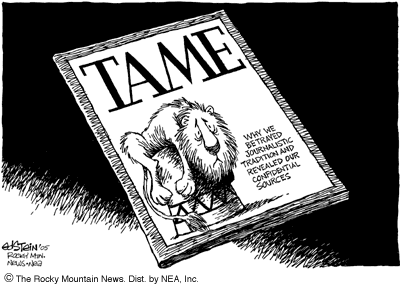
It would be fair to say that many journalists are upset about Time’s decision to turn over notes to a grand jury regarding the Valerie Plame leak.
That’s not because journalists don’t take what happened to her seriously — quite the contrary, all the journalists I’ve discussed it with realized how much potential impact this would have on her work and the lives of her contacts the moment Robert Novak released her name — or because journalists are lawbreakers as a category.
There is a fear, probably a legitimate one, that confidential sources will be less likely to speak to journalists if they know their names will come out in the end anyway. (They sure won’t be in a hurry to talk to reporters for Time.) As I noted recently, most journalists don’t want to publish stories featuring the words of a person who doesn’t want their name on the record. I’ve been in newsrooms where management actually forbade it, although given good enough reason, they’d relent.
Because sometimes there is a good reason: Let’s imagine that the local police department is rife with corruption, and a non-uniformed staffer has information to prove crimes have been committed. That staffer has a strong belief that her life would be in danger if she came forward to expose this information, and that filing charges would be just as bad and accomplish even less. So what does she do? She goes to a reporter and becomes an anonymous source.
Now, anonymous tips are used more often than they appear to be to readers and viewers, because the way journalists (and publishers, who are the ones who have to pay for the lawyers) prefer to use anonymous tips is as a springboard to getting information on the record from sources you can name. Much like tough love parenting, when you come to someone knowing the truth, very often, the people you confront fold and starting telling you the truth, even if it’s only pieces of it that you will have to assemble manually on your own. Used in this way, anonymous sources suffer very little risk of exposure, since the focus will shift to the people who speak on the record and give their names. But even here, there’s an initial risk involved — that anonymous source stuck their neck out, even if only briefly. (This is typically referred to as getting information “off the record,” but it really amounts to the same thing as an anonymous source.)
But sometimes, even that doesn’t work. Much like the teenager with icewater in their veins when confronted by their parents, often people with something to hide will be able to stonewall a journalist and they and their associates will present a united front. In those cases, the question of what to do becomes trickier.
I’ve been in more than one newsroom where I was told, typically with regret, but not always, that if I used an anonymous source, and ended up on the wrong side of the legal system, I was on my own, since the paper simply didn’t have the money to fight the legal challenge. (The public would likely be horrified if they realized how much of the local media operates just pennies from the red at all times.) And, while I realize this probably has a chilling effect on how aggressively reporters are willing to do their jobs (and aggression is sometimes necessary, even for those of us who realize you catch more flies with honey than with vinegar), it’s hard to argue with the papers’ position on this.
But it certainly isn’t the case with Time. So while reporters may not like using anonymous sources more than anyone else, if it’s felt to be necessary, they’d expect Time, if anyone, to be able to afford to back reporters up.
Myself, I don’t know how I feel: The Supreme Court made its decision, and I definitely respect the rule of law. I’m also someone who believes that democracy has been well-served on a number of important occasions by the use of anonymous sources. I do know it’s a mess and I do know that I’m surprised that Time made the decision they did.
In any case, I suspect this is far from over. There is a renewed push for a federal shield law, which would give certain uses of anonymous sources legal protection (31 states and the District of Columbia already have them), so we will likely hear more about this debate in future weeks and months, not to mention the eventual results of the Novak investigation.
No Comments »
No comments yet.
RSS feed for comments on this post.
Leave a comment
Line and paragraph breaks automatic, e-mail address never displayed, HTML allowed: <a href="" title=""> <abbr title=""> <acronym title=""> <b> <blockquote cite=""> <cite> <code> <del datetime=""> <em> <i> <q cite=""> <s> <strike> <strong>