
Nothing said on this site should be taken as representing the views of Freedom Communications or the Daily Press family of newspapers.
In a weird way, I’m starting to think the case of Judith Miller might actually be good for journalism.
For some years now, I’ve been depressed at the trend towards more and more timid reporting, on all levels. If there weren’t the off-chance my grandmother or very techie publisher were going to wander by and see this, I’d likely use stronger language to describe what I think of a lot of the reporting over the past decade or so.
The Judith Miller case is causing the industry, which was always given to the sort of endless introspection and navel-gazing normally only found in freshman philosophy majors, to suddenly realize they still have their cojones. (Sorry, Grandmother.) It’s partially a proprietary sense of outrage — “How dare they come after one of US?” as though Judith was the type to call up random small-town newspapers and take the newsroom out for beers and a round-robin on current events — but it’s also because of what she’s in jail for.
She did not, in fact, write anything about Valerie Plame. She was told something (quite important) about Valerie Plame. This is something that won’t necessarily seem as important to non-journalists as it actually is: Every day, we get told a LOT of things off the record. In a single one hour interview this afternoon, I was probably told seven or eight things off the record. And, contrary to what some TV shows or movies might lead one to believe, “off the record” does not mean “you won’t report on this.” It means “you won’t report on this using my name and my information.” Reporters can, and do, take off the record info and pursue other sources for the same information — it’s a whole lot easier breaking something loose when you know what you’re looking for. In other words, off the record information is, essentially, the most everyday version of anonymous sources.
In this brave new world, those seven or eight things I heard off the record could land me in jail, if someone was upset enough that I knew about them. Now, the truth is, most off the record information just isn’t that interesting or scandalous except to the person asking it not be printed in the paper. It would rarely be printed even if it had been on the record. It’s personal information about their lives or what they really think about someone but would be impolitic to say in public. But often enough, it’s something real. Since being at the Hesperia Star, I can think of one major story that would definitely fall under the shadow of the Judith Miller case insofar as how I originally obtained the information. It was a story that, if I can risk being immodest a moment, Hesperians were better off having made public, and one that powerful folks were unhappy about me writing at the time. If Judith Miller had gone to jail 12 months ago, it might never have been published.
And that’s what’s scared and upset so many journalists. After years of not doing their jobs, or phoning it in, it feels — rightly or wrongly — like the government isn’t going to let them do those jobs at all, not in the way they know they should. And suddenly, the slumbering Fourth Estate has woken up.
Better late than never.
New York Magazine has put together a cheat sheet for the Plame/Miller case. (Source.)
Editor Doug Clifton talks about the two stories his paper, the Cleveland Plain Dealer, is sitting on, for fear of the legal ramifications if they go forward with them.
Slate defends Time’s decision to turn over Matthew Cooper’s notes.
More from Salon, responding to yet more letters on this issue, this time spurred by their previous essay on why the issue is bigger than Miller.
An American Journalism Review survey finds that 69 percent of Americans agree with the statement “journalists should be allowed to keep a news source confidential.” But other survey results are much less positive for journalists, including the news that only 33 percent of respondents think the media tries to report without bias. Ouch!
The July 15 edition of On the Media talks about this more, including a discussion of what the fallout for the Plain Dealer actually is, as compared to how some people have been spinning it, intentionally or otherwise.
It looks like we’re having an intern for all of three days this summer, so I’ll be dropping my pearls of wisdom here, instead of in an intern’s ear.
At my first newspaper, the News Messenger of Christiansburg, Virginia, my editor was the inimitable Debbie Haerr. I was new to newspaper writing, having gone to college to become a disc jockey, and changed course towards becoming a television reporter after ending up in an Electronic News Gathering class. I had written a total of one newspaper article while I was in college, for the campus paper, but my folks were moving to Egypt and the TV stations weren’t calling (yet) and my girlfriend suggested I go ahead and apply to the News Messenger.
“What the hell,” Debbie said, for some reason. “I’ll give you a shot.”
It was an amazing time, where I would literally find myself improving in my writing and news gathering skills (two separate skill sets, as I’ll explain some other time) expanding on a daily basis. I was full of questions, and in Debbie, I was fortunate enough to have a willing mentor to answer them. Debbie had been an award-winning reporter right out of the chute in the Midwest, and was full of good insights.
Not surprisingly, as I had been a Communications major with a broadcasting concentration, I had never thought to take a shorthand class or anything like that. I had a great deal of trouble writing fast enough to keep up with people speaking, and as getting a quote right is incredibly important — even if the substance is right, being off on the wording undercuts the reporter’s credibility with that source to a degree — I asked her if I should get a tape recorder and record interviews.
“No. You won’t listen to what they’re saying if you tape.”
I thought about this.
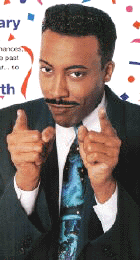 That night, I went home to my basement apartment in Blacksburg and watched “The Arsenio Hall Show.” He was interviewing Michael Jordan, as I recall. If not Jordan, then some big deal NBA star who had been interviewed hundreds, perhaps thousands of times in his life, and was very comfortable with the process. Talk show guests are typically pre-interviewed by show staff who go over topics, find the best ones to ask about and prepare the good questions for the host on 3″ x 5″ cards. And Arsenio dutifully worked his way through the cards, asking the questions of Jordan. And Jordan, being a veteran interviewee, was funny and charming, and gave great answers, as he tends to do. And after he finished, Arsenio would ask the next question. That night, I went home to my basement apartment in Blacksburg and watched “The Arsenio Hall Show.” He was interviewing Michael Jordan, as I recall. If not Jordan, then some big deal NBA star who had been interviewed hundreds, perhaps thousands of times in his life, and was very comfortable with the process. Talk show guests are typically pre-interviewed by show staff who go over topics, find the best ones to ask about and prepare the good questions for the host on 3″ x 5″ cards. And Arsenio dutifully worked his way through the cards, asking the questions of Jordan. And Jordan, being a veteran interviewee, was funny and charming, and gave great answers, as he tends to do. And after he finished, Arsenio would ask the next question.
And then, Jordan stopped, slowly looking over at Arsenio.
“I just answered that.”
Jordan, it turns out, had jumped ahead in the conversation, expanding on the answer of one question and already giving the answer of what should have been the next question. Arsenio was flustered, and shuffled his cards nervously.
“You weren’t listening to me, were you?” Jordan asked, his mouth smiling, but not his eyes.
The upshot: I don’t use a tape recorder.
Next week at this time, we’ll talk “inside baseball.”
Nothing said on this site should be taken as representing the views of Freedom Communications or the Daily Press family of newspapers.
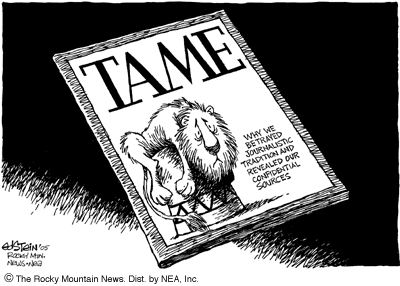
It would be fair to say that many journalists are upset about Time’s decision to turn over notes to a grand jury regarding the Valerie Plame leak.
That’s not because journalists don’t take what happened to her seriously — quite the contrary, all the journalists I’ve discussed it with realized how much potential impact this would have on her work and the lives of her contacts the moment Robert Novak released her name — or because journalists are lawbreakers as a category.
There is a fear, probably a legitimate one, that confidential sources will be less likely to speak to journalists if they know their names will come out in the end anyway. (They sure won’t be in a hurry to talk to reporters for Time.) As I noted recently, most journalists don’t want to publish stories featuring the words of a person who doesn’t want their name on the record. I’ve been in newsrooms where management actually forbade it, although given good enough reason, they’d relent.
Because sometimes there is a good reason: Let’s imagine that the local police department is rife with corruption, and a non-uniformed staffer has information to prove crimes have been committed. That staffer has a strong belief that her life would be in danger if she came forward to expose this information, and that filing charges would be just as bad and accomplish even less. So what does she do? She goes to a reporter and becomes an anonymous source.
Now, anonymous tips are used more often than they appear to be to readers and viewers, because the way journalists (and publishers, who are the ones who have to pay for the lawyers) prefer to use anonymous tips is as a springboard to getting information on the record from sources you can name. Much like tough love parenting, when you come to someone knowing the truth, very often, the people you confront fold and starting telling you the truth, even if it’s only pieces of it that you will have to assemble manually on your own. Used in this way, anonymous sources suffer very little risk of exposure, since the focus will shift to the people who speak on the record and give their names. But even here, there’s an initial risk involved — that anonymous source stuck their neck out, even if only briefly. (This is typically referred to as getting information “off the record,” but it really amounts to the same thing as an anonymous source.)
But sometimes, even that doesn’t work. Much like the teenager with icewater in their veins when confronted by their parents, often people with something to hide will be able to stonewall a journalist and they and their associates will present a united front. In those cases, the question of what to do becomes trickier.
I’ve been in more than one newsroom where I was told, typically with regret, but not always, that if I used an anonymous source, and ended up on the wrong side of the legal system, I was on my own, since the paper simply didn’t have the money to fight the legal challenge. (The public would likely be horrified if they realized how much of the local media operates just pennies from the red at all times.) And, while I realize this probably has a chilling effect on how aggressively reporters are willing to do their jobs (and aggression is sometimes necessary, even for those of us who realize you catch more flies with honey than with vinegar), it’s hard to argue with the papers’ position on this.
But it certainly isn’t the case with Time. So while reporters may not like using anonymous sources more than anyone else, if it’s felt to be necessary, they’d expect Time, if anyone, to be able to afford to back reporters up.
Myself, I don’t know how I feel: The Supreme Court made its decision, and I definitely respect the rule of law. I’m also someone who believes that democracy has been well-served on a number of important occasions by the use of anonymous sources. I do know it’s a mess and I do know that I’m surprised that Time made the decision they did.
In any case, I suspect this is far from over. There is a renewed push for a federal shield law, which would give certain uses of anonymous sources legal protection (31 states and the District of Columbia already have them), so we will likely hear more about this debate in future weeks and months, not to mention the eventual results of the Novak investigation.
For more on this, check out Yahoo! News’ Full Coverage of Media Issues, which is currently dominated by stories, editorials and related coverage of this case from a variety of sources.
KCRW’s To the Point also discussed the issue this week.
As if to provide an example of the other side of the anonymous sources issue, the LA Times gets publicly burned for trusting anonymous sources without rigorous fact-checking. Oops.
The Daily Press’ Opinion page ran this commentary by Kathleen Parker of the Orlando Sentinel as well as this editorial originally from the San Jose Mercury News.
The Christian Science Monitor weighs in.
It turns out that the Cleveland Plain Dealer is sitting on two stories of “profound importance” because of this issue. (Source.)
The July 8 edition of On the Media devotes about half of the hour-long show to this issue, including discussion of what sort of federal shield law at least one legal scholar thinks is a good idea.
 The Pew Research Center for the People and the Press just released the results of a new study into how Americans feel about the media. It’s good news and bad news. The Pew Research Center for the People and the Press just released the results of a new study into how Americans feel about the media. It’s good news and bad news.
The bad news is that, overall, trust in the media has declined. The good news is that, unless you work at the New York Times or Washington Post, it’s not by much.
By wide margins, more Americans give favorable than unfavorable ratings to their daily newspaper (80%-20%), local TV news (79%-21%), and cable TV news networks (79%-21%), among those able to rate these organizations. The margin is only slightly smaller for network TV news (75%-25%).
In addition to the favorable/unfavorable results, the favorables dropped like this: Daily newspapers dropped 2 percent, local TV news by 4 percent, cable network news by 9 percent, national network news by 1 percent and national newspapers like the Times and the Post dropped a whopping 13 percent, which now are languishing with a 61 percent favorable rating. At this point, local newspapers are the most trusted media source, but only with a 1 percent margin over local and cable TV news.
Much-publicized attacks on the press by politicos tend to focus on the big name papers, which is probably why their brands have lost some of their luster, while papers that people tend to be more familiar with, like their hometown papers, are known quantities that are seen as not having the same sorts of problems those other papers have.
This isn’t me taking a political stand with this analysis: The study found a divide in how Democrats and Republicans view the media, which definitely suggests the hammering the press have gotten from right wing critics in recent years has had a real impact with the intended audience. (Obviously, the NYT’s well-publicized problems have had their own bipartisan impact on the paper’s reputation.)
The partisan gap on this issue has grown dramatically, as Republicans increasingly express the view that the press is excessively critical of the U.S. (67% now vs. 42% in 2002). Over the same period, Democratic opinions on this have remained fairly stable (24% now vs. 26% in 2002).
Republicans are now closely divided as to whether the press protects or hurts democracy; 40% say it protects democracy, while 43% believe it hurts democracy. Two years ago, by a fairly sizable margin (44%-31%) more Republicans felt that the press helped democracy. Democratic opinion on this measure has been more stable. In the current survey, 56% say the press protects democracy while just 27% say it hurts democracy.
Views on whether the press is politically biased have been more consistent over the years. More than seven-in-ten Republicans (73%) say the press is biased, compared with 53% of Democrats. Perceptions of political bias have increased modestly among members of both parties over the past two years.
Interestingly, while fewer Democrats tend to view the press as biased, a growing number of them think the media hasn’t been tough enough of President Bush: 54 percent say the media aren’t “criticial enough” of him, compared to 39 percent a year ago. I suspect that has more to do with evolving opinions about the presidency on that side of the aisle than it does the press — the war in Iraq and other issues are likely much more important in shaping that sort of opinion than anything the news media have done in particular. Presidential election results may have also created a sour grapes effect as well, right or wrong. It’s something I’ve seen in local politics and with local readers for many years.
The newspaper industry has been terrified to varying degrees by the rise of the Internet — which is probably something worth exploring in more detail at another time — but the news here wasn’t bad, if one assumes that many newspapers will eventually fully adapt to the challenges ahead, albeit with some soul-searching and probably some pain along the way:
The current study includes two measures that provide some insight into this growing news source. First, by a 90%-6% margin, respondents who say they rely on newspapers as a main source almost universally mean the printed version of the paper, not the online version. Second, when respondents cite the internet as a main source, most are including their use of online newspapers. Fully 62% of internet news consumers say they read the websites of local or national newspapers.
Combined, these questions indicate that while 40% of Americans count the printed newspaper as a main source of news, another 16% are reading newspapers as part of their internet news consumption. The relevance of online newspaper readership is most important among younger Americans. While only about a third of those under age 40 count the printed newspaper as a main source of news (compared with half of those age 50 and older), another 20% say the online version is at least a part of their internet use. While younger people tend to consume far less news overall than their seniors, newspapers  in one form or another  remain a key part of the media mix for majorities in all age groups.
Of all the traditional media, I’ve always felt the newspaper industry was the best-poised to prosper under the Internet paradigm — just look at how omnipresent the Associated Press and Reuters wire services are online now; they’re part of pretty much every major Internet news site, like Yahoo! News and Google News.
There’s a detailed breakdown of who reads newspapers online. Interestingly, it’s most popular among self-described “moderates” politically.
Where the views of online newspaper readers differ more dramatically is in their evaluations of mainstream media organizations. People who read the newspaper online have a far less favorable opinion of network and local TV news programming than do people who read the print version, and also have a somewhat less favorable view of the daily newspaper they are most familiar with. But consumers of online newspapers feel far more favorably toward large nationally influential newspapers, such as the New York Times and the Washington Post.
Again, I’m guessing that’s the familiarity factor coming into play again. And, of course, if you’re an online consumer of news, the major sites have the finances to have a lot of stuff there for you, between larger news staffs and all the bells and whistles generally.
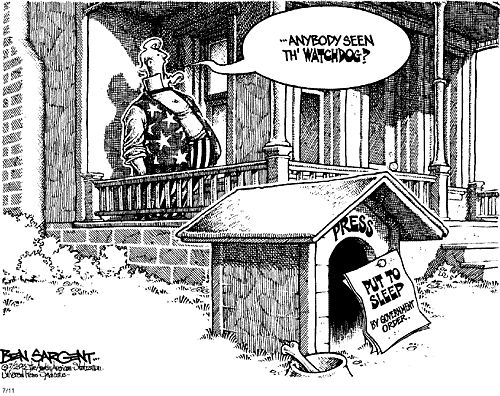
Interestingly, the public seems to be split on the media’s role as a watchdog, something again that I’ve seen in my professional life:
Beyond the rising criticism of press performance and patriotism, there also has been significant erosion in support for the news media’s watchdog role over the military. Nearly half (47%) say that by criticizing the military, news organizations are weakening the nation’s defenses; 44% say such criticism keeps the nation militarily prepared. The percentage saying press criticism weakens American defenses has been increasing in recent years and now stands at its highest point in surveys dating to 1985.
By contrast, public support for the news media’s role as a political watchdog has endured and even increased a bit. Six-in-ten Americans say that by criticizing political leaders, news organizations keep political leaders from doing things that should not be done; just 28% feel such criticism keeps political leaders from doing their jobs. Two years ago, 54% endorsed the press’s role as a political watchdog.
In my experience, even the politicians tend to be generally OK with the press being a watchdog, so long as they can see you sniffing around other politicians the same way, and aren’t singling them out. I’ve only had one serious run-in with an elected official about this in recent memory, whereas I’ve put quite a few under the microscope in public. Most of the politicians, including those under the microscope, know it’s a “Godfather” thing: It’s business, not personal.
Here’s an interesting bit that defies conventional wisdom, or at least what I would have guessed to be true:
By nearly three-to-one (68%-24%), Americans believe it is better if coverage of the war on terror is neutral rather than pro-American.
Of course, it’s likely that people’s perception of what constitutes neutral coverage may be colored at times by their political beliefs. Ask someone how Clinton and Bush were treated by the media, and the answers almost invariably tell you how they vote, I find.
And the use of anonymous sources come under scrutiny as well, with the results mirroring, I think, how most journalists tend to feel: It’s acceptable in certain circumstances, but it still makes everyone a bit nervous.
About half (52%) say the use of such sources is too risky because it can lead to inaccurate reports, while 44% say it is okay because it can yield important news that they otherwise wouldn’t get. People who say they paid very close attention to the Deep Throat story are much more positive about the use of confidential sources than those who paid less attention to this story (60% vs. 41%).
But most Americans think the use of confidential sources is at least sometimes justified. Over three-quarters (76%) think reporters should sometimes be allowed to keep their sources confidential if that is the only way to get information, while 19% say reporters should always reveal their sources. Despite the recent visibility of the Deep Throat story, opinions on this question are no different today than they were twenty years ago.
That definitely mirrors what I’ve been hearing in newsrooms since 1992, when I started my professional career.
The following is the list of urbanized areas in California affected by the governor’s May 18 proclamation regarding casinos in urbanized areas, as per an attachment sent out by his office at the same time as the initial release.
CITIES IN “URBANIZED AREAS,”
AS DEFINED IN PUBLIC RESOURCES CODE § 21071, SUBDIVISION (a),
AS OF MAY 18, 2005
Alameda
Albany
Alhambra
Anaheim
Antioch
Apple Valley
Artesia
Azusa
Bakersfield
Baldwin Park
Bell Gardens
Bellflower
Belmont
Benicia
Berkeley
Beverly Hills
Brea
Brentwood
Buena Park
Burbank
Burlingame
Calabasas
Camarillo
Campbell
Carlsbad
Carson
Castro Valley
Ceres
Cerritos
Chino
Chino Hills
Chula Vista
Citrus Heights
Claremont
Clovis
Colton
Compton
Concord
Corona
Coronado
Costa Mesa
Covina
Culver City
Cupertino
Cypress
Daly City
Dana Point
Diamond Bar
Downey
El Cajon
El Cerrito
El Monte
Elk Grove
Emeryville
Encinitas
Escondido
Fairfield
Fontana
Foster City
Fountain Valley
Fremont
Fresno
Fullerton
Garden Grove
Gardena
Glendale
Glendora
Goleta
Hawaiian Gardens
Hawthorne
Hayward
Hermosa Beach
Hesperia
Hidden Hills
Highland
Huntington Beach
Inglewood
Irvine
La Canada Flintridge
La Habra
La Palma
La Verne
Laguna Hills
Laguna Woods
Lake Forest
Lakewood
Lancaster
Lawndale
Livermore
Lomita
Long Beach
Los Angeles
Los Gatos
Lynwood
Manhattan Beach
Menlo Park
Milpitas
Mission Viejo
Modesto
Montclair
Montebello
Monterey Park
Moreno Valley
Morgan Hill
Mountain View
Murrieta
National City
Newark
Newport Beach
Norco
Norwalk
Oakland
Oakley
Oceanside
Ontario
Orange
Oxnard
Palmdale
Palo Alto
Palos Verdes Estates
Paramount
Pasadena
Perris
Pico Rivera
Piedmont
Pittsburg
Placentia
Pleasant Hill
Pleasanton
Pomona
Port Hueneme
Poway
Rancho Cucamonga
Rancho Palos Verdes
Rancho Santa Margarita
Redlands
Redondo Beach
Redwood City
Rialto
Richmond
Riverside
Rocklin
Rolling Hills Estates
Rosemead
Roseville
Sacramento
Salinas
San Bernardino
San Bruno
San Buenaventura (Ventura)
San Clemente
San Diego
San Dimas
San Fernando
San Francisco
San Gabriel
San Jose
San Juan Capistrano
San Leandro
San Marcos
San Marino
San Mateo
San Pablo
Santa Ana
Santa Barbara
Santa Clara
Santa Clarita
Santa Fe Springs
Santa Monica
Santa Rosa
Santee
Saratoga
Seal Beach
Sierra Madre
Signal Hill
Simi Valley
South El Monte
South Gate
South Pasadena
South San Francisco
Stanton
Stockton
Suisun City
Sunnyvale
Temecula
Temple City
Thousand Oaks
Torrance
Tustin
Union City
Upland
Vallejo
Victorville
Vista
Walnut
Walnut Creek
West Covina
West Hollywood
West Sacramento
Westminster
Whittier
Yorba Linda
Yucaipa
|
|
|
|